Title Image

History

Forum Dança - Sofia Dias & Vítor Roriz | PACAP 6 | © Joana Linda

PACAP 6
2023

Performing Arts Advanced Programme

Curated by Sofia Dias and Vítor Roriz

From February 16 to July 30, 2023

APPLICATIONS ARE CLOSED

Open until June 20, 2022

Presentation

In each epoch there are voices coming from the future that demand urgent and necessary changes in the present. The voices that reach us today from the future seem to suffer from that almost mute hoarseness of someone who, for years, repeats the same thing to exhaustion. Despite the countless declinations and formulations, more or less prosaic and poetic, that message from the future comes in a question as simple as this: “if you already know what needs to be done, why don’t you do it?” And it is not the apparent aphonia that makes these voices inaudible, but the voluntary effort to minimize, ignore or postpone them. Camus, in The Myth of Sisyphus, comes to a synthesis that seems to us linked to the root of this deafness “…practical consent and simulated ignorance, (…) makes us live with ideas that, if we actually felt them, should transform our whole lives.” This contradiction between ideas and practice is a fertile place of artistic questioning for what it reveals of the futility of the barriers between the desire for transformation and action or the difficulty of some communities in letting go of the “bone” of privilege, not only over other communities, but over nature itself.


Alongside the unpredictability of what is to come, the obsolescence of some of the tools of thought and action that characterize our society, the voices that announce it, the resistance to hear them, there is a future to be imagined and to which we are already contributing actively or passively. PACAP is one of these places of imagination and experimentation where the circumstances of the world are in dialogue with the specificities and subjectivities of each artist and, therefore, a special place for the debate of our contradictions. The work of each artist communicates more or less directly with the multiple temporalities that constitute reality, influencing and absorbing it, being part of it and sometimes distancing themselves to create parallel worlds that guarantee a critical perspective on what goes on around us. In the curious balance between the particular and the universal, we see how the approach to what is most singular and specific in each artist has the capacity, not infrequently, to affect more people than those who are part of their usual circle. And in these successive affections we contribute to the diversity of imaginaries about the body, identity and relationships.


The PACAP, as a provisional community, is also a place for the composition of relationships between each participant, for the articulation between the individual and the collective, for experimentation with other interaction dynamics that overlap with those of privilege and power, such as care, generosity, attention, collaboration.


The PACAP calls for intensity simply because it is a long-term community. This awareness of the end gives the added energy and urgency needed to spark unusual relationships and excesses that escape control but are indispensable to the imagination. We can use this energy of being together to provoke either a re-centering or a slight shift in our ways of thinking/doing.


For all this, we know that beyond the incredible group of artists we invite to be with us, what makes the PACAP experience unique is the constellation of participants that will integrate this Program. We would like, therefore, to invite 16 people with the desire and the pleasure of experimentation, to imagine with us multiple futures through projects whose starting points can be a simple quality of movement, an urgent and current concept, a banal idea, an intuition to name, an object out of place, or any other thing that provokes the necessary restlessness to create.

Structure

PACAP 6 is structured in five moments:


  • Moment 1 – Temporary community, from 16 February to 10 March;
  • Moment 2 – Laboratories, meetings and conversations, from March 13 to May 19;
  • Moment 3 – Research and Creation, from May 22 to July 2;
  • Moment 4 – Public Presentation, from the 3rd to the 23rd of July;
  • Moment 5 – Reflection/feedback, production and finishing, from the 24th to the 29th of July.


Access the tabs to find out more information about each of these moments that make up the program’s structure.

MOMENT 1

Temporary Community

[from February 16 to March 10]

PACAP 6 is a temporary community with a fixed duration of six months. And as a community we need to find ways of coexistence where the combination of the heterogeneities of each artist translates into a greater capacity for action. The way we constitute ourselves as a community, although in large part random and involuntary, depends on particular attention to the composition of relationships so that no way of thinking/doing is disqualified and so that the diversity of perspectives and freedom of action is preserved. This will be an unstable composition in continuous mutation throughout the six months, but to which we dedicate ourselves in this first moment.


Residency
PACAP 6 begins with a six-day residency with Sofia and Vítor. In this residency, we will start by sharing the projects with which each artist applied to this program, as well as their references and personal practices. Simultaneously we will explore a series of methodologies of collaboration and collective reflection in a logic of reciprocity, care, and circulation of ideas.


Laboratory with Sofia & Vítor
During eight days, Sofia and Vítor will share some of their research tools, while accompanying each artist in the preparation and presentation of a short performance/rehearsal from the individual projects. To watch these performances/essays we will invite the circle of accomplices of PACAP. This will be the first and still intimate opening of this temporary community to the outside world, in a movement of expansion and aggregation.


Visits to local structures
In these first weeks we will visit several spaces of presenting, researching, and experimenting in the performance arts in Lisbon and can talk with the people who coordinate them. These visits are a first contribution for the mapping of Lisbon by each artist and intend to make easier their communication with these structures as potential partners.

MOMENT 2

Laboratories, meetings, and conversations

[from March 13 to May 19]

The second moment of PACAP will be a moment of critical incorporation of influences, practices, perspectives and wishes of a group of invitees in different types of encounters.


Research laboratories
We have tried to congregate an eclectic group of 8 artists who, during twelve weeks, will share their ways of research and creation in laboratories that will last from 5 to 10 days.
Confirmed artists: Alex Cassal, Christine de Smedt, João FiadeiroLigia Lewis, Marcelo EvelinSheena McGrandles, Simone Aughterlony and Vera Mantero.


Creative response
The research labs will finish with a moment of creative/critical response from each participant. This response is intended to return a look or feedback to the guests to sediment the experience of the laboratory and put into dialogue elements of this research with the individual projects. The creative/critical response will be an opportunity to experiment with different presentation/performance formats.

Occasional Encounters / Crash Meetings
Among the eight research laboratories there will be occasional meetings with artists living or passing through Lisbon. The duration of these meetings varies from just a few hours to a day, and their format is open and flexible. Crash Meetings are an opportunity to include local artists and expand the temporary community of PACAP 6. Besides the curatorial choices, there is room for suggestions from participants of PACAP 6, to meet collective interests and needs.
Confirmed artists: François Chaignaud.


Conversations/seminars
For PACAP6 we invited a few people to broaden and deepen the reflection and discussion on the themes/subjects we want to address in this program, namely, creative appropriation, the tension between form/content, the relationship of artistic creation with ecology, identity, and activism, among others. There will be a particular focus on the concept of “bridging the divide” which could be freely understood as to “bringing together those who are divided”. Here representatives of two projects that operate according to this concept will share their experience, particularly in trying to bring together people from radically different political spectrums. The concept of “bridging the divide” along with the search for tools for dialogue with those we consider to be at odds with our convictions (not only political but also artistic) are a fundamental axis in the reflection and action of PACAP 6. In these conversations/seminars there will also be room for the suggestions of each participant.
Confirmed guests: Hanna Israel (Europe Talks).


Parallel Program
A program of shows and performances in different cultural spaces in Lisbon will be proposed to the group of participants of PACAP 6. Collective viewing makes it possible to create a common reflection plan not only on the shows, but also, by mirror effect, on the practices of each PACAP participant. It is easier to discuss and apply some concepts with a performance as a common reference. This parallel program takes place outside PACAP hours, and attendance is optional.

MOMENT 3

Research and Creation

[from May 22 to July 2]

For 6 weeks, each PACAP participant will work on individual creation projects. It is a period accompanied by Sofia and Vítor, by peers of PACAP and by local instigators chosen by each participant. A collaboration methodology will be proposed where each participant puts herself at the service of one or more projects so that this creative process is as closely monitored as possible and to take advantage of the main resource of this program: the pairs.

At the beginning of this process, a production plan will be made in collaboration with the Forum Dança team to adapt the existing resources or find others necessary for the realization of the project. In the fourth week of creation there will be an informal presentation and feedback session. During the last phase of the creative process, technical support will be guaranteed for the implementation of the project at Teatro do Bairro Alto and Culturgest.


Documentation
A documentation project of the creative process of each participant will be developed in collaboration with an artist and graphic designer. In a first phase, materials will be collected to create a personal archive. This archive will then serve as a field of experimentation for the creation of a documentary object that can dialogue directly with the “studio” work or go in an autonomous direction.
Marta Ramos will collaborate during this process.

MOMENT 4

Public Presentation

[from July 3 to 23]

The six-week creative process will culminate with public presentations of each participant’s projects at the Bairro Alto Theater (TBA) and Culturgest in Lisbon. One of the partners will mainly host projects that fit into the theatrical space while the other will host projects for unconventional spaces, namely outdoor space (gardens, street, open-air auditorium, etc.). This diversity of presentation contexts and the respective technical and logistical support of the teams of these cultural institutions seeks to meet the diversity and specificity of the proposals of each participant. Thus, the presentation formats depend exclusively on the creation process and the artistic intentions of each participant, which can either result in a show or performance or in a lecture, collective practice, installation, sound experience, guided tour, among many other options. PACAP’s public presentations are a moment of celebration, of expanding the relations of this temporary community and of collective reflection.


Sharing of Documentation
The period of the public presentation will also be the opportunity to share, in one of the spaces of the Bairro Alto Theater, a collective composition of the personal archives, showing the lines of force, specificities, approximations and distances between each project. This temporary composition serves both as an introduction to the projects and as a support point for later reflections and discussions.


Register
A complete photographic and video recording of each presentation will be made. These records will be given to the participants for the documentation and/or dissemination of the project.

MOMENT 5

Reflection/feedback, production, and finishing

[from July 24 to 29]

Reflection and feedback
Back to the intimacy of Forum Dança studios, this final moment of PACAP 6 is dedicated to reflection and feedback on the journey of each participant during the six months of the Program, with special focus on the creation process and the public presentation. In this reflection/feedback we will count on the presence of the instigators of each project.


Production support
Parallel to this reflection and feedback moment, each participant will have production and dissemination support. Depending on the stage each project is at, this support may consist of the elaboration of a production and/or dissemination dossier; research for and contact with institutional partners for the development and/or presentation of the project; application to residencies, support and grants for creation and/or circulation; clarifications about the Portuguese context of support to the arts and the status of the arts worker; among others.


Finishing Documentation
In this last moment of the Program, we are going to create a collective documentary object that tries to integrate and put into dialogue the elements of individual research, with the experience of different laboratories, occasional meetings, seminars and performances presented at Teatro do Bairro Alto and at Culturgest.


Temporary community
In the same way that at the beginning of the six months special attention is given to the formation of this temporary community, at this moment of the Program it will also be fundamental to take care of its end.

Informations

Target audience

Dancers, choreographers, performers and other artists with performance, body, and movement practices, older than 23 (with no upper age limit).

The program is open to applications from individual and duet artists.

Note
PACAP will have English and Portuguese as its working language, according to the Program participants.

A minimum knowledge of these languages is required, although this is not a determining criterion for the selection of candidates.

Guests

Invited artists and structures:


Moment 2 | Research Labs


Moment 2 | Occasional Encounters/Crash Meetings


Moment 2 | Talks/Seminars


Moment 3/4 

Selection Process

The selection process will be carried out by the curators of PACAP 6 and the direction of Forum Dança.

It will take place in 2 distinct Phases:


  • Phase 1 – Applications;
  • Phase 2 – Auditions.


Candidates must present a synopsis of a project to be developed within the scope of PACAP 6. This synopsis is nothing more than a starting point, an unfinished idea, an unsolved problem.

Phase 1

Applications


The submission of applications is done through an online form (further down this page) until June 20, 2022. Applications will be accepted in Portuguese, English or French.


Please Include the following documents:


  • Motivation letter (max. 1 page A4 .pdf format) or video (link max. 3 minutes);
  • CV with photo and short biographical note (max. 2 pages A4 .pdf – not to exceed 1MB);
  • Candidate’s Portfolio Link with texts, images and links to videos (max. 10 pages A4, in .pdf format);
  • Synopsis of a project to be developed within the scope of PACAP 6 (max. 1 page A4, pdf).


Candidates selected for an audition will be contacted by June 30, 2022 by email.

! IMPORTANT NOTE !

Please do not send links to download videos and photos.

Links sent must give direct access to the online visualization of the files (YouTube, Vimeo, etc.).

We only accept as downloadable files the CV, the motivation letter, and the project/synopsis.

Phase 2

Auditions


This second phase will only be for the candidates selected in the first phase.


  • Audition Dates: 5 to 10 September 2022
  • Place: Forum Dança, Lisbon, Portugal.


Communication of results: all selected candidates will be contacted by email until 30 September 2022.


Note

For foreign residents unable to travel to Lisbon, an audition and online interview will be held between September 5 and 10, 2022 at a time to be arranged with each candidate.

Tuition fees

  • Registration: 120€.
  • Payment in full: 1800€.
  • Payment in two instalments: 950€ x 2.


Attention: The tuition fees are payable by each participant, even if they apply as an artist duo.


Please apply even if the tuition fee is an impediment.
If the amount of the tuition fee is an impediment, please attach a letter explaining your financial condition to your application.

Scholarships

Four scholarships will be awarded:


  • 1 scholarship with 100% reduction of the total fee, exclusively addressed to artists from Portuguese-speaking African Countries (PALOP);
  • 1 scholarship with 75% reduction of the total fee, exclusively addressed to black artists living in Portugal;
  • 2 scholarships with a reduction of 50% of the total fee, for 2 artists who can assure the simultaneous translation of the PACAP sessions for small groups.


Please apply even if the tuition fee is an impediment.
If the tuition fee is an impediment, please attach a letter explaining your financial condition to your application.

Schedules

Monday to Friday from 10 am to 5 pm.

This schedule is only indicative and may change.

A detailed program plan will be delivered to each PACAP 6 participant.

Application

Form

Applications are closed.

Curatorship

Sofia Dias & Vítor Roriz
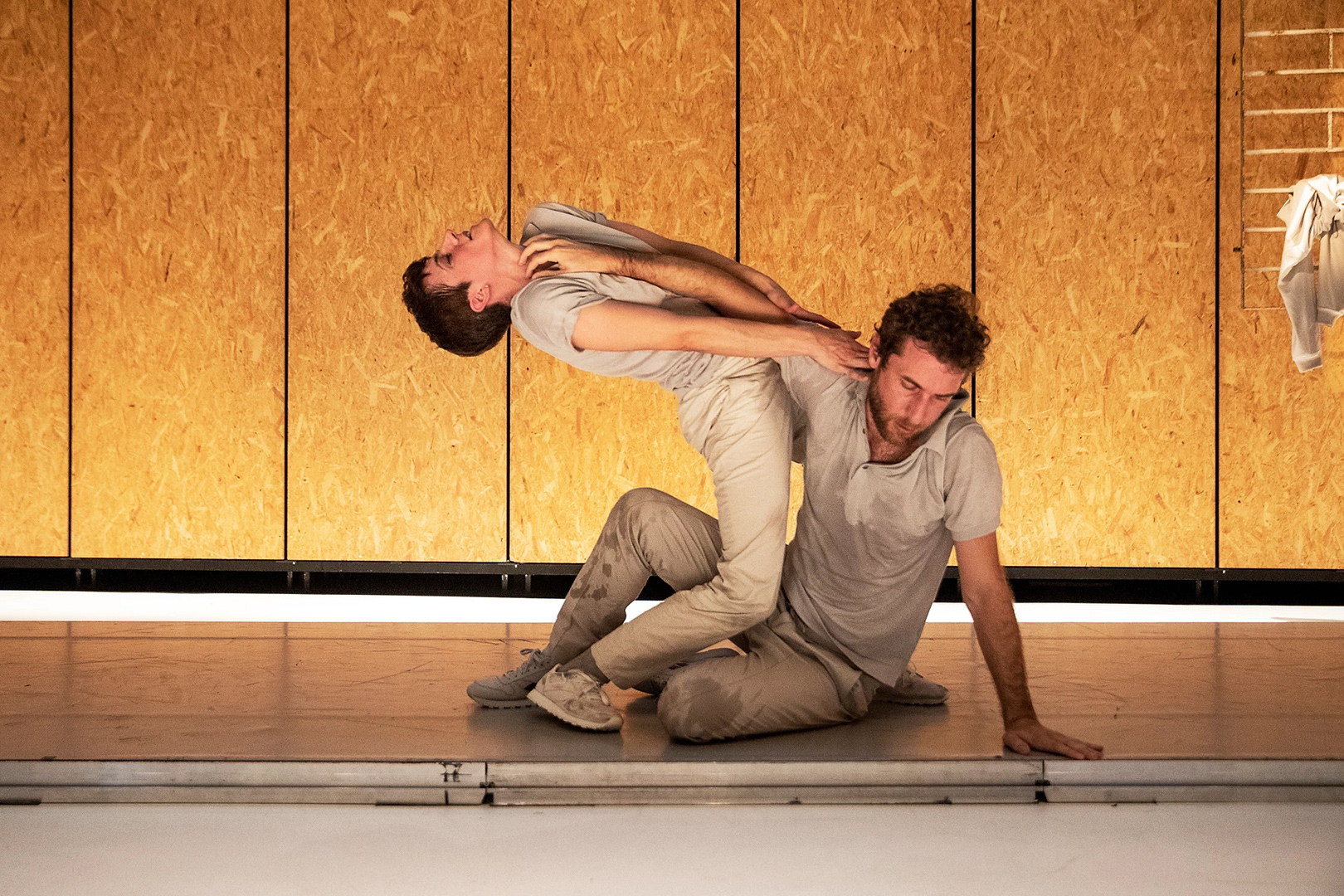
"O que não acontece", Sofia Dias & Vítor Roriz © Filipe Ferreira

Sofia Dias and Vítor Roriz are a duo of artists collaborating since 2006. The hybrid nature of their research, connected to a strong curiosity and need for experimentation, led them to the create several shows, performances, videos, podcasts and installations, crossing different contexts and blurring limits between artistic fields.


Their performances conceived for stage, mainly performed by the duo, summon up a particular choreographic language in relation to text and voice, as manifested in the pieces A gesture that is nothing but a threat 2011 (Prix Jardin d’Europe and 1ºAerowaves Spring Forward) and What does not happen 2018, both still touring. Besides their shows in duet, Sofia and Vítor have been also creating with and for other performers, invited by companies, such as Companhia Instável 2010, or Companhia Maior 2019; and in their own productions such as Satellites (2015), Escala (2021) or their first piece for children, Sons Mentirosos Misteriosos 2020 [Misterious Lying Sounds].

"Arremesso IX", Sofia Dias & Vítor Roriz, 2021 © Musiberia

With approximately 30 projects conceived over the last 16 years, Sofia and Vítor spread their research to other mediums and contexts. As in the radio piece De olhos fechados [With eyes closed] for OSSO (2021), the video work Contorno [Contour] created for the third edition of Traça (2020), the sound piece Gas pier in Lisbon by Sound (2014), or in the series of performances for non-conventional spaces presented since 2011, Arremesso. A series that counts already with nine different performances that search for reactivating and re-signifying the archive of gestures, movements, texts, musics, soundscapes, voices and “states of presence” they have been collecting throughout their collaboration.

Although the artistic creation is a mark in the path of this duo, their first collaboration, in 2006, was Project MOLA – Movimento latente – a project of informal artistic education for children and adults from different social and economic backgrounds that kept active till 2010. The duo’s educational activity continued in the professional context after an invitation by Companhia Instável in Porto to teach a workshop. Since then, Sofia and Vítor regularly run workshops and classes in Portugal and abroad, in the context of the festivals where they present their works, or in formal and informal institutions of education/training/research, like C.e.m. – Centro em movimento (Lisbon), La Place de la Danse CDCN (Toulouse) and ESAD (Caldas da Raínha). Since 2010 they keep a close relationship with Fórum Dança (Lisboa), where they were invited to make the curatorship of the second edition of PACAP – Advanced Program of Creation in Performing Arts (2018/19) and by whom they were challenged for the curatorship of the 6th edition of the same Program in 2023.


The growing interest for forms of sharing and reflection among pears, lead them to develop and take part, since 2012, of various residencies and meetings between artists, highlights include AWARE in the context of Alkantara Festival. Sofia and Vítor are usually requested for “feedback sessions” and “outside view” for multiple performative arts’ projects.
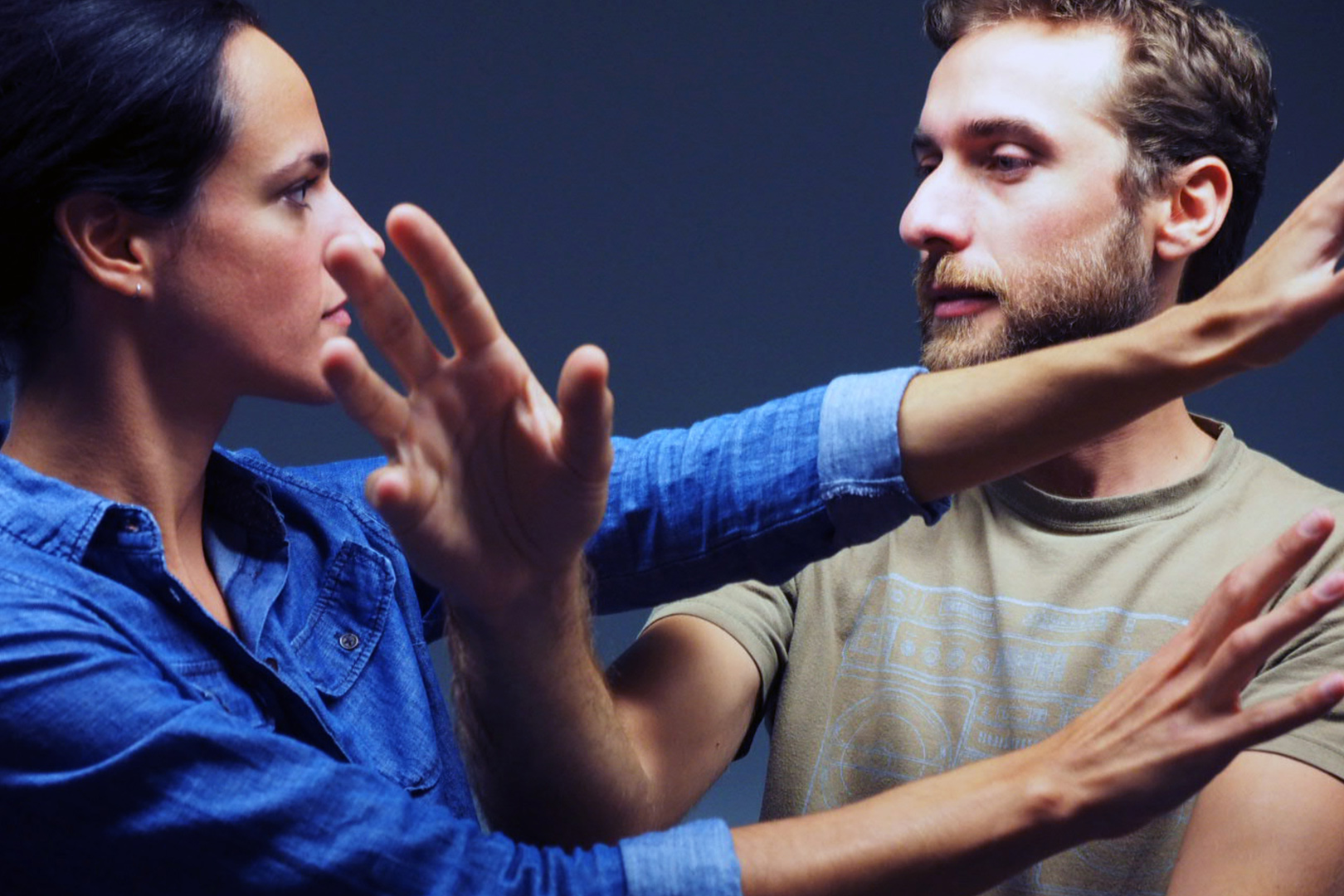
"António e Cleópatra", from Tiago Rodrigues with Sofia Dias & Vítor Roriz, 2014 © Magda Bizarro.

As a duo, they were invited to collaborate with several artists, such as Catarina Dias (Potlach), Lilia Mestre (Beyond Mary and Joseph), Lara Torres (An impossible wardrobe for the invisible), Gonçalo Waddington and Carla Maciel (At most mere minimum), Marco Martins and Clara Andermatt (Durações de um Minuto), Marco Martins (Two maybe more), Mark Tompkins (improvisation based on In C), Tim Etchells (The exhibition of a film), Felipe Hirsch (Opera Orphée). They have been collaborating regularly with Tiago Rodrigues as performers in Antony and Cleopatra 2014 (still on tour in its Portuguese, French and English versions) and Sopro 2017. In 2020 they did movement assistance for the piece Catarina e a beleza de matar fascistas, by the same author.

Since the beginning of their collaboration they are supported by many different structures: O Espaço do Tempo, being associate artists between 2009 and 2016, the former Bomba Suicida in the period from 2006 to 2009 and Materiais Diversos that, between 2012 and 2016 took charge of the production, diffusion and administration of all artistic activity of the duo. They can not fail to mention Alkantara and Devir/CAPA for the support given to their creative work. They have collaborated with the structures of production and cultural diffusion SUMO and Something Great and currently they rely with the production of Agência 25.


Along these years they have enjoyed the significant support of the European networks Looping, TRANSFER, Aerowaves, Open Latitudes, Modul Dance, ONDA and Départs.
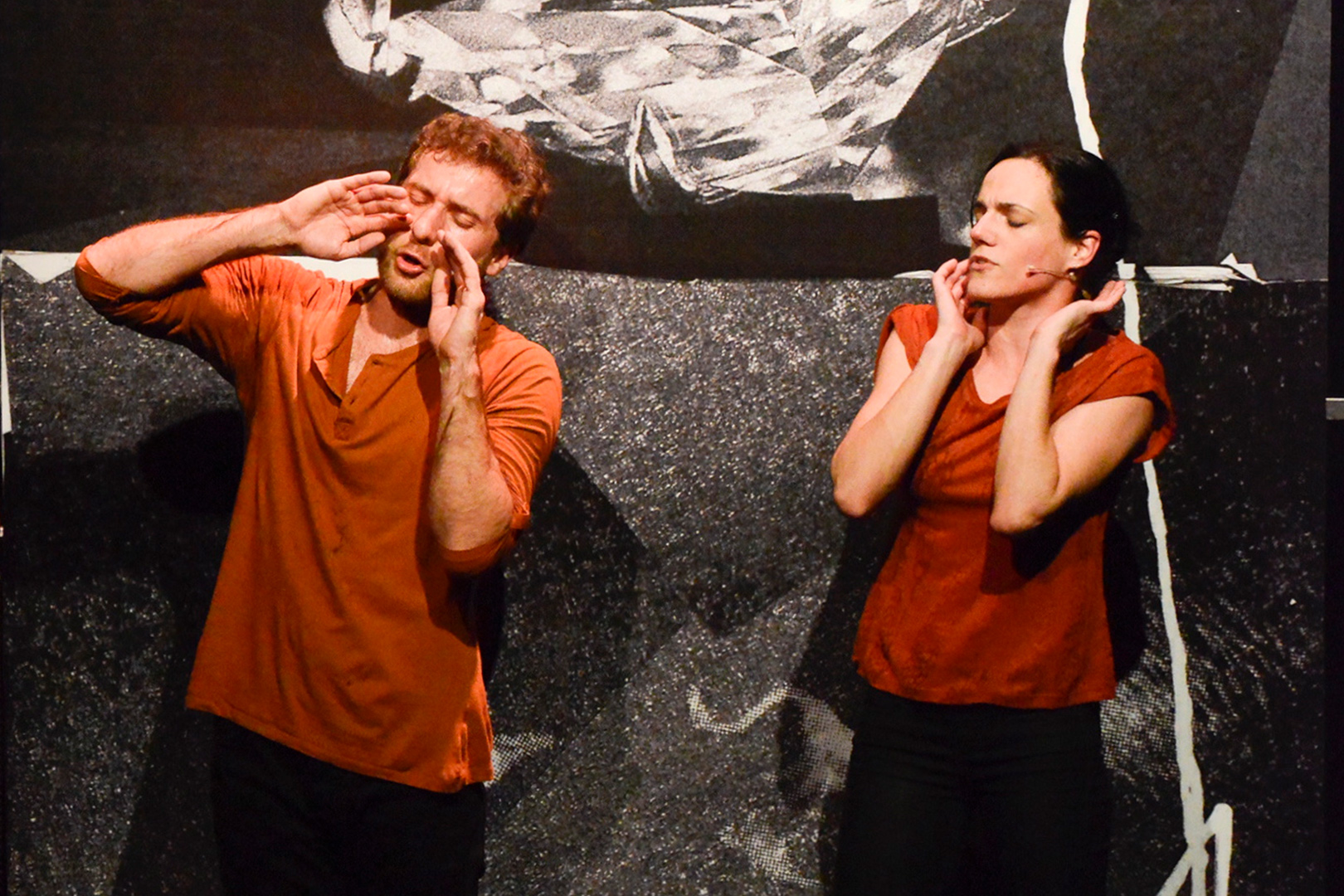
"Fora de qualquer presente", Sofia Dias & Vítor Roriz, 2012 © Paulo Pacheco.

In 2020, they’ve developed the project Infiltration at Teatro do Bairro Alto that concluded with the piece Escala.

In 2022 they were Featured Artists at GUIDance Festival.

In 2022/2023 Sofia and Vítor will be “Novos Inquilinos” [New tenants] at Teatro Viriato in Viseu.

Their next piece, NEVERODDOREVEN, in collaboration with Filiz Sizanli and Mustafa Kaplan will premiere in November at Alkantara Festival and will be presented in Viseu, Paris and Porto.


Sofia Dias & Vítor Roriz are associate members of REDE – Associação de Estruturas para a Dança Contemporânea [Contemporary Dance Structure’s Association].

Participants

Bobby Brim (FR), Camilla Morello (IT), Connor Scott (UK), Estrellx Supernova (US), Lorea Burge (UK/ES), Lucas Damiani (UY), María Ibarretxe del Val (ES), Marcelo de Castro Pereira (BR), Mariana Catalina Iris (UY), Rafaela Santos (PT), Silvana Ivaldi (PT), Tarlie Lumby (UK), Vanessa Lonau (DE) e Victor Lattaque (FR).

PACAP 6 activities

Top banner image credit © Joana Linda

Coproducers and Support

Coproducers PACAP 6: Teatro do Bairro Alto and Culturgest

Support PACAP 6: Casa da Dança – Almada, Fundação GDA, O Rumo do Fumo, Alkantara, OPART | Estúdios Victor Córdon, O Espaço do Tempo, Piscina.

Forum Dança | Parcerias e Apoios PACAP 6
Talk "My Dance History", by Marcelo Evelin

Marcelo Evelin

20 February 2022, at 16h00
ESPAÇO DA PENHA – LISBON
Approximate duration: 2 hours

Free entry, subject to registration.


Marcelo Evelin is a dancer, choreographer and researcher. He lives between Teresina and Amsterdam and works in Brazil, Japan and several European countries as an independent artist at the head of Plataforma Demolition Incorporada, based at CAMPO, a space for Residency and Resistance in the Performing Arts in Teresina, Piaui.

Her shows ‘De Repente Fica Tudo Preto de Gente’, ‘Batucada’ and ‘A Invenção da Maldade’ are currently touring theatres and festivals around the world.

He has been teaching at the Amsterdam School of Arts since 1999 and has been creating projects at universities and master’s programmes, including ISAC (Brussels), Reina Sofia Museum (Madrid), EXERCE (Montpellier) and CND (Paris).

In 2019 he was awarded the title of Doctor Honoris Causa by the Federal University of Piaui.


Photo © Marc Domage


This lecture has the support of Casa da Dança de Almada

Talk "My Dance History", by Eszter Salamon

Eszter Salamon

13 November 2021, at 12.30 p.m. [Barcelona]
Auditori Meier | MACBA – Museu d’Art Contemporani de Barcelona – BARCELONA
Approximate duration: 90 min.

This talk takes place in partnership with La Poderosa – Espai per la dansa i ele seu contaminants, as part of the cycle HACER HISTORIA(S) VOL 4 . CYCLE OF CONTEMPORARY DANCE AND PERFORMANCE.


PRESENTIAL | Free entry, subject to prior enrolment.

ONLINE | Live broadcast to Portugal upon registration to access the link.

Eszter Salamon, artist, choreographer and performer. She lives and works between Paris, Berlin and Brussels. Since 2001, she has created solo and group works, presented at theatres and festivals around the world, including Centre Pompidou, Centre Pompidou Metz, Festival dʼAutomne, Avignon Festival, Ruhrtriennale, Holland Festival, The Kitchen New York, HAU Berlin , Berlin Documentary Forum, Kunstenfestivaldesarts, Kaaitheater Brussels, Tanzquartier Wien, Kampnagel Hamburg, steirischer herbst, Dance Triennale Tokyo, Manchester International Festival, PACT Zollverein, Nanterre-Amandiers, FTA Montreal.
His work is frequently shown in museums such as MoMa, Witte de With, Fondation Cartier, Serralves, Museum der Moderne Salzburg, Akademie der Künste Berlin and Museo Reina Sofia. The exhibition Eszter Salamon 1949 was presented in 2015 at Jeu de Paume, as part of ‘Satellite’ curated by Nataša Petrešin-Bachelez.
Eszter Salamon uses choreography as an activating and organising agent for various media, such as image, sound, text, voice, body movement and actions.
In 2014, she began a series of works exploring both the notion of the monument and the practice of speculating about making history.
She won the Evens Prize in 2019.


Photo © Bea Borgers

Forum Dança - João Fiadeiro | PACAP 5

João Fiadeiro

4 November 2021, at 18h30
VICTOR CÓRDON STUDIOS – LISBON
Approximate duration: 2 hours

Free entry, subject to prior registration.


Born in 1965, João Fiadeiro belongs to the generation of choreographers that emerged at the end of the 1980s and gave rise to New Portuguese Dance.
His career, whether as a choreographer or performer, or as a researcher or curator, has centred on creating conditions for experimentation, laboratory practice and interdisciplinary cross-fertilisation. This activity has been carried out both within the framework of directing artistic programming and research projects, which have included the Centro Cultural da Malaposta (1990-95), Espaço Ginjal (1995-1998), Lugar Comum (1999-2000), Espaço A Capital (2000-2002) and Atelier Real (2004-2019), and within the framework of his artistic practice, through the creations and research workshops organised around Composition in Real Time.
In all these different meeting platforms, João Fiadeiro has always been accompanied by artists who have actively participated as creators, performers, researchers and programme-makers, making a decisive contribution to the project’s existence over 30 years of uninterrupted activity.


Photo © Ana Viotti

Talk "My Dance History", by Lisa Nelson

Lisa Nelson

10TH ANNIVERSARY LECTURE SERIES ‘MY DANCE STORY’

27 October 2021, at 18h30
PALÁCIO GALVEIAS LIBRARY – LISBON
Approximate duration: 2 hours

Free entry, subject to prior registration.

10TH ANNIVERSARY LECTURE SERIES ‘MY DANCE STORY’
Celebration of the 10th anniversary of the lecture series ‘My History of Dance’, created from Lisa Nelson’s seminar for Forum Dança’s PEPCC course in 2009.

Lisa Nelson is a Tuning Scores practitioner and explorer of the role of the senses in performance and movement observation. She is interested in danced behaviour, systems of transmission and translation, patterns of survival in the face of culture, and the sense of imagination. Alongside dance, she has dedicated her life to publishing in various media, including video and the journal Contact Quaterly, since 1976. Her writing is available online at www.movementresearch.org and also at www.oralsite.be. He lives in Vermont, USA.


Photo © Mandoline Whittlesey

Talk "My Dance History", by Cláudia Dias

Cláudia Dias

20th October 2021, at 18h30,
PALÁCIO GALVEIAS LIBRARY – LISBON
Approximate duration: 2 hours

Free entry, subject to prior registration.

Cláudia Dias was born in Lisbon in 1972. She is a choreographer, performer and teacher. She began her dance training at the Academia Almadense, was awarded a scholarship at the Companhia de Dança de Lisboa, completed the Contemporary Dance Performers Training Course at Forum Dança, and attended the Master’s Degree in Performing Arts at the Faculty of Social and Human Sciences, Universidade Nova de Lisboa. She began her work as a performer with the Almada Dance Group. She was a member of the collective Ninho de Víboras. She collaborated with Re.Al and was a central interpreter in João Fiadeiro’s creative strategy and in the development, systematisation and transmission of the Real-Time Composition Technique. She created the pieces Feedback, E.U. (entrevista-me urgentemente), Juntem-se 2 a 2, As águias não geram pombas, Per Ti, Histo, One Woman Show, Visita Guiada, Das coisas nascem coisas, Vontade de ter Vontade, 23 + 1 and Nem tudo o que dizem tem de ser feito nem tudo o que fazemos tem de ser dito. She was an associate artist at Re.Al and Espaço do Tempo and a resident artist at Alkantara. She has published texts in the magazines Boa União and Woman On Scene and in the books Correspondencias.Bad and Escenas do Cambio. Awarded by the Portuguese Arts and Ideas Club in the Young Creators competition, 1998. Nominated for the Best Choreography Award in 2013 and 2017 by the Portuguese Society of Authors. Since 2016 she has been developing the project Sete Anos Sete Peças (Seven Years, Seven Pieces), accumulating functions of direction, creation, interpretation and training. He created the association Sete Anos.


Photo © Alípio Padilha

Talk "My Dance History", by António Pinto Ribeiro

António Pinto Ribeiro

15th July 2021, 6.30pm, Alcântara Library
Approximate duration: 2 hours

Free entry, subject to prior registration.

António Pinto Ribeiro
With a degree in Philosophy and a PhD in Cultural Studies, his professional activity is divided between cultural programming and research. He began his essay work in the area of the ‘Arts of the Body’ at the Escola Superior de Dança, followed by his role as programme assistant at ACARTE. He was a dance critic for Expresso, a contributor to Forum Dança and was, since its foundation, the artistic director of Culturgest (1993-2004) and director of programmes at the Calouste Gulbenkian Foundation (2004-2015), including the Gulbenkian Next Future Programme dedicated to the arts and cultures of the global south. The curator responsible for several international exhibitions, he was also the commissioner-general of ‘Lisbon Ibero-American Capital of Culture 2017’. He is currently a researcher at the Centre for Social Studies at the University of Coimbra, as part of the ERC project ‘MEMOIRS – Children of Empire and European Post-Memories’ and is an international programmer. He has published dozens of articles and sixteen books, including: ‘Dance in the age of cinema’, ‘Temporary contemporary dance’, ‘History of dance in Portugal’ (with José Sasportes), ‘Body to Body, possibilities and limits of criticism’. His latest publication is entitled ‘Peut-on Décolonizer les musées?’ (2019).

Forum Dança - João Fiadeiro | PACAP 5

PACAP 5
2021/2022

Performing Arts Advanced Programme

Curated by João Fiadeiro

in collaboration with Márcia Lança, Carolina Campos and Daniel Pizamiglio.

from September 13th, 2021, to July 30th, 2022

Introduction

PACAP 5’s programming will aim to provide a diverse and non linear approach towards artistic research, employing as reference the study and experimentation of improvisation through Real Time Composition (bloc I); collaborative practices starting from a shared question (bloc II); and practices of individual research for each participant (bloc III). Depending on their interests and availability, participants will be able to opt for a 3, 6 or 9 month course. In order to do the second and third blocs participants must attend the previous ones. The number of participants will decrease as the course progresses: 24 in the first bloc, 16 in the second and 8 in the third and final one, thereby establishing different intensities and ways of involvement with the different research practices of decision, collaboration and creation proposed within the course.

João Fiadeiro and some members of the Atelier RE.AL Collective (Márcia Lança, Carolina Campos and Daniel Pizamiglio) will be present during the entire duration of the course in order to replicate the laboratorial practice that has always characterized our activity. This aims to produce a sense of continuity between blocs and create the condition to deepen the research experience, which would be difficult to implement if the course were structured around a more fragmented and punctual participation of external guests. Regardless, running parallel to a more constant relationship with the Atelier RE.AL Collective we will invite artists and researchers to direct occasional workshops associated with the subjects being explored in each bloc. With these invitations we aim to create a critical distance with regards to our practice, to tune in to other ways of thinking-doing artistic research and generate some breathing room between the cycles.

Proposal

Facing the current global crisis, and as much for the stunning speed with which the hegemonic world tries to return to “normal” as for the monumental uncertainty that we keep experiencing, it is urgent to be more careful of our surroundings, more aware of details and more sensible to differences. It is very clear today that the systems’ sustainability and resilience does not result from our capacity to answer but from our ability to question. Specifically, our ability to frame the question. That is why a question like “not-knowing together” is so important. It acknowledges that it is not about knowledge or consumption. It is about savoring, questioning and imagining the world. Together.

Throughout the course we’ll aim to keep pressure “on the wound” implied by that question, repeating from different angles in different scales with different intensities and resisting the temptation to answer it. So that different formulations arise, different ways of being emerge, different positions present themselves. Somewhere, within all those differences, the “common” will appear. And when that happens we must be present to welcome it. Maybe that is our only responsibility: to show up when the present summons us.

To understand events from this perspective (to face not-knowing as the only thing we have) is what motivates us in designing this course as a durational practice of being in the now. We are confident that it is here, in this gap opened in time, faced with the impossibility of proceeding, that the real possibilities of action are found. Because if it is true that interruption can immobilize us (through the suspension of our expectations), it can also be an unique opportunity to deactivate the habit of letting ourselves be taken in by the frenetic economy of attention the regimes of organizing and controlling desire submit us to. The personal and collective experience that results from the suspension of knowledge is, in this perspective, a key element in our political, civic and artistic bearings.

It is in that gap – between the moment we collide with what affects us and the moment we relate to its possible manifestations – that the act of imagining, of disarranging and rearranging our perceptions, may take place. That exploration does not seek to stop movement nor to focus on it to the point of objectification. To explore the gap does not mean to propose an experience of contemplation or passiveness and even less to prioritize an embodiment of deep ennui as a space of creation. What this approach proposes is to exercise our abilities to move perception towards the periphery of the event, towards the infinitesimal relations that go through us and that can even contradict themselves. What this approach proposes is to find movement within pause. Time within time. The experience of coming to halt and taking notice.

“Notice” in portuguese means “reparar”. And “reparar” can be understood as re-parar (to stop again), to restore, to notice. Those three meanings, when activated simultaneously, are extremely powerful. This gesture of coming to a halt and taking notice (of pausing, of consideration and of paying attention) is but an exercise of commitment to the present that, subsequently, creates the conditions for the development of a sense of responsibility towards our surroundings and towards each other. / Curatorial Team

Informations

Select each of the sections below to learn about all the programme specifications, applications and selection process.

Locations where the course will take place

Target audience

The course is aimed at dancers, choreographers, performers and other artists whose practices relate to performance, body and movement. Applicants should position themselves as peers and not students and see artistic creation as a space of research through art, meaning a platform for the exploration of processes of correlation, collaboration and decision in an environment that does not distinguish between theory and practice and promotes permeability between subjects, thereby regarding the work of art as a consequence of a process and not as its end.

Note

  1. The language of the course will be English and Portuguese, depending on who is guiding the session and the needs of each moment.
  2. Scholarships will be awarded to 3 participants, after acceptance in the program, who can ensure simultaneous translation for small groups. The scholarship consists of a reduction of 50% of the total fee.

Programme timeline

Bloc I

Study, experimentation and practice of Real Time Composition
September 13 until December 11, 2021

Bloc II

Collaboration processes based on a shared question
January 17 until April 16, 2022

Bloc III

Individual investigation processes of each participant
April 26 until July 30, 2022

Confirmed guest artists

Bloc I

Lisa Nelson (USA), Romain Emma-Rose Bigé (FR).

Bloc II

Coletivo Hormigonera (UY), David-Alexandre Guéniot / GHOST (PT), Orquestina de Pigmeos (ES), Projeto Companhia – João dos Santos Martins (PT).

Bloc III

Eleonora Fabião (BR), Gustavo Sumpta (PT), La Ribot (ES), Luara Learth/Acauã Elbandido (BR), Mette Edvardsen (NO).

Applications process

The submission of applications is done solely and exclusively through the form available below. Applications will be accepted in Portuguese or English, and must include:


  • Motivation letter or motivation video where the applicant addresses the reasons why he or she is applying. (1 A4 page maximum in pdf format or a 3 min video maximum – in the case of sending a video, you must submit a link where it can be viewed)
  • Curriculum vitae with picture and biography (2 A4 pages maximum in pdf format)
  • Link to Portfolio focusing on the applicants work with texts, images and links to video documentation (10 A4 maximum in pdf format)
  • Contact information of two individuals with whom the applicant has had a relationship (professor, curator, programmer, collaborator, etc.) and that can provide an external perspective of the applicant’s profile.
  • Clear indication of the blocs that the applicant intends to attend (I, I+II or I+II+III). It is only possible to attend the second or third bloc having attended the previous blocs.


! WARNING !
We ask that you do not send, with your applications, links to your work in the form of file download. Links should only be available for viewing files online.
We only accept your CV and your cover letter as a downloadable file, everything else must be freely accessible and online.

Selection process

Bloc I+II+III (9 months)

  • Course calendar: September 13, 2021 to July 30, 2022
  • Application deadline: 29.01.2021
  • Selection phases dates:
    • 12.02.2021 ›› Announcement to pre-selected candidates
    • 15 to 19.02.2021 ›› On-line workshop
    • 22 to 26.02.2021 ›› Individual interviews with curatorial team
    • 01.03.2021 ›› Communication of results

Bloc I+II (6 months)

  • Course calendar: September 13, 2021 to April 16, 2022
  • Application deadline: 12.03.2021
  • Selection phases dates:
    • 19.03.2021 ›› Announcement to pre-selected candidates
    • 22 to 26.03.2021 ›› On-line workshop
    • 29.03.2021 to 02.04.2021 ›› Individual interviews
    • 05.04.2021 ›› Communication of results

Bloc I (3 months)

  • Course calendar: September 13, 2021 to December 11, 2021
  • Application deadline: 16.04.2021
  • Selection phases dates:
    • 26.04.2021 ›› Announcement to pre-selected candidates
    • 03 to 07.05.2021 ›› On-line workshop
    • 10 to 14.05.2021 ›› Individual interviews
    • 17.05.2021 ›› Communication of results

Note

  1. Individual on-line interviews will be scheduled with the direction of Forum Dança on a date to be defined.

Fees

Bloc I (3 months)

  • Registration: 100€, payable until one week after admission to the course.
  • Tuition fees: Bloc I: 300€ x 3 months

Bloc I+II (6 months)

  • Registration: 100€, payable until one week after admission to the course.
  • Tuition fees: Bloc I+II: 290€ x 6 months

Bloc I+II+III (9 months)

  • Registration: 100€, payable until one week after admission to the course.
  • Tuition fees: Bloc I+II+III: 270€ x 9 months

Notes

  1. Tuition fees must be paid until the 30th of the previous month. The first payment must be made until 30 August 2021.
  2. If the course is paid in full until 30 August 2021 a 10% discount will apply.
  3. Scholarships will be awarded to 3 participants, after acceptance in the program, who can ensure simultaneous translation for small groups. The scholarship consists of a reduction of 50% of the total fee.

Schedules

Monday to Friday from 10 am to 5 pm.

Synopsis

Select each of the sections below to learn about the different synopses for each of the blocs that make up this programme.

Bloc 1. Study, experimentation and practice of Real Time Composition

The proposal for this bloc will be to immerse ourselves (intensively and extensively), in ways of researching, experimenting and applying Real Time Composition (Composição em Tempo Real), a (theoretical) practice and a (practical) theory that positions itself as a field (as in a place, a territory) with the sole purpose of welcoming the forces at play in each instant in what we conventionally designate as “present”. From Real Time Composition’s perspective, inside this present time is simultaneously “no longer” and “not yet”. A non-linear time, experienced as a Möbius strip where interior and exterior, before and after, form and force, merge and confound.


Before any presentations or introductions, the course’s first week will begin with a collective performance involving the 24 participants entitled “O que fazer daqui para trás” (loosely translatable as “What to do from here on backwards”), in its expanded version. This is how we’ll present ourselves: through action and through the traces our positions leave behind. Only in the second week will the group have the time to get to know each other better and share their individual paths.


Throughout the duration of the bloc João Fiadeiro will be accompanied by Márcia Lança and Daniel Pizamiglio (with 15 and 10 years’ experience in Real Time Composition, respectively). We will also have the continuous presence of “text-worker” Romain/Emma Bigé, a French trans*feminist philosopher and dancer with whom João Fiadeiro has collaborated many times (namely as co-curator of the show “Draftings Interior Techniques”, on Steve Paxton’s work and legacy). Romain/Emma will organize weekly seminars that place Real Time Composition’s experimental practices in relation with (in her own words) “dance’s capacity for celebrating wryd and rare forms of tenderness between humans & other critters of Terra. She will offer Textual Practices, including: Sexy Library (because reading is sexy), Blind Book Club, Conceptual Speed Dating and other Marvels to think with texts and bypass the cortex”. The choreographer and improviser Lisa Nelson will also be present, running a two week workshop focusing on her “Tuning Scores” research. Among João Fiadeiro’s peers that deal with ways of  think-operate decision and performance, Lisa is the one with whom he has the most affinities and an enormous respect. Her presence will serve not only to share with the participants the absolutely singular practice of this american artist, but also to  put in relation two composition and improvisation tools that share an enormous amount of questions and research topics.


This bloc will culminate with two weeks dedicated to the study, experimentation and reenactment of the performance EXISTENCE (EXISTÊNCIA), taking place at Lisbon’s Teatro do Bairro Alto (a PACAP 5 strategic partner and co-producer). EXISTENCE premiered in 2002 at Paris’ Centre Pompidou and was João Fiadeiro’s only project where Real Time Composition took place in a public setting, placing performers and audience in a space of radical engagement with the present and with the idea of know-knowing together. The EXISTENCE experience was structural in the systematization and processing of Real Time Composition as a tool and deeply influenced dozens of choreographers, performers and artists that went through that project. The visual artist Walter Lauterer and the musician Arnold Noid (that respectively handled the real time composition of space and sound in the original project) will be in Lisbon for the public presentations with the course’s participants.

Bloc 2. Collaboration processes based on a shared question

In this second bloc (now reduced to 16 participants) we want the group to keep working with the issue of collaborative processes, but this time from a common questioning standpoint (an approach positioned between the “absence of a previous question” explored in the first bloc and the existence of an “individual question” to be explored in the third bloc).


This is an issue that has occupied João Fiadeiro’s practice since the 1990’s and that in a certain way was the reason why a tool like Real Time Composition began being developed. At the time the ambition was to develop a common language that enabled a shared experimentation field but without letting that language restrict us (condemn us) into following a previously established direction (usually dictated by the author). But at the same time we weren’t interested in developing an exclusively horizontal experience because we knew that simply removing the author from the equation wouldn’t stop the power structures, now implicit, from taking hold of the narrative.


What we found is that there is a colossal difference in the way this “diagonal strategy” of addressing collaboration is applied if we are facing the perspective of an individual decision (as when improvising or even in solo work) or that of an collective decision (as it happens in group projects). While at the individual level the “matter of the affect” can remain in the shadow, protected from light and labeling (and afford the luxury of only revealing itself at the end), at the collective level if the affect (what moves and connects us) is not shared at the beginning of the collaborative process then group dynamics can easily fall into conflictual or submissive modes of relation. What we strive for is the creation of conditions for relations based on “reciprocal” approaches to be formed and, along the way, to deactivate binary logics where one either tries to convince someone else of its opinion or subjugates itself to theirs.  A reciprocal relationship implies that we share “the affect” and the forces at play at the moment of our encounter (by definition vulnerable, incomplete and fragile). It implies that we listen and pay attention to the (weak) signals that the event is sending us. In one sentence: implies accepting that we do not know (together).


How to identify, circumscribe and share a collective affect in a way that we can then work the relation and the encounter? And how is it possible to create a shared vital force that allows the finished work to translate an unrest which is transversal to everyone and not a patchwork of tendencies, desires and disperse questioning?


These questions will be the starting point for the research in the second bloc. They will be placed and managed mainly by the voices (and the bodies) of those that have experienced first-hand the tension between authorship, authority, authorization and autonomy: the performers and co-creators of the group works. This research period will then be exclusively mediated by Márcia Lança and Carolina Campos with the occasional presence of João Fiadeiro. Not only did Márcia and Carolina had central roles in the creation of the RE.AL’s group pieces but, in recent years, they have been working together in co-authorship on different projects where these questions occupy a prominent place.


The results of the research developed in this bloc will also be presented at Teatro do Bairro Alto, in a format and configuration to be defined.


In parallel to this continuous research, instigated and mediated by Márcia and Carolina  (but developed in a self-organized manner by the course’s participants), we will have the participation of some invited collectives that will function as “case studies” by sharing their practices, experiences and questions regarding collaborative creation. Firstly we will welcome João dos Santos Martins with the project  Companhia (Company), created in a collective manner in 2018 (by the same group that created the “Projecto continuado” in 2015). The project focuses on the term “company”, simultaneously referring to the idea of a dance company, the company of other people and the notion of collective and interdependency that exists in the community experience. Secondly we’ll have the Hormigonera project – meaning concrete mixer in english  -, a collaborative creation practice that researches dramaturgical processes and alternative modes of collaboration. It is driven by a group of Uruguayan artists working in the languages of space, matter, light and sound to invoke performative action with the aim of giving a voice to “poor” and “marginal” materials and putting themselves, as artists, in service of their agency. Lastly, we will have the catalan collective Orquestina de Pigmeos, that operates between performance, sound and cinema, working mostly in site-specific environments in close proximity with local communities. Finally in this bloc we’ll also have the participation of David-Alexandre Guéniot, director of the publishing company GHOST, who will develop a project with the participants that will culminate in an artist(s) book produced in a collective manner.

Bloc 3. Individual investigation processes of each participant

Having arrived at this stage of the course, now with 8 participants, the focus will switch to the individual research of each participant. João Fiadeiro, Carolina Campos and Daniel Pizamiglio will mainly function as facilitators of the research process so the participants can   use the tools previously  labored and experimented in the  first and second blocs and transfer them towards their individual research.  The final presentation – that will once again take place at Teatro do Bairro Alto –  may take the form of a work in progress, a prototype or even a “work” as long as  the focus will not be on the product but in the process. What we are interested in questioning and identifying are the adequate ways of presentation so that the potency encompassed in the initial question can be translated in such a way that there is a correlation between the artist’s initial affect and the action made public.


This public dimension of the sharing process is fundamental so that the “other” stops being idealized and there is the recognition that a gesture is only really concluded when it is received by a third party. It is often in this moment of “collision” with  the other that we realize clearly if what we said-did was exactly what we wanted to do-make. it rarely is. But what matters, especially in a training- and researching frame, is the recognition of that difficulty so that, from there, we can fail again. “Fail better”, as Beckett puts it.


During the bloc we will be visited by five artists – La Ribot, Gustavo Sumpta, Mette Edvardesen, Eleonora Fabião and the duo Luara Learth / Acauã Elbandido – who will share with the group the way they “failed” to get to the research place where they are. These are artists that share similar assertions in the relation they develop with the artistic gesture, mainly in what concerns their work ethics and radical commitment with the present time. They also have in common a critical positioning towards their disciplines, not letting themselves be captured by any type of artificial and manipulative labeling.  Despite these contact points we made sure of having contrasting artists, on a formal, geographical and generational level.


Our expectation is that access to their ways of operating will impart on the participants this simple equation: even if the ways leading up to the construction of a work (gesture, action) will always be multiple, it will invariably be as a result of the collision (and relation) between our strengths  and our vulnerabilities (between poetry and savagery), that something vital and urgent can emerge.

Participants

Aline Belfort (BR), Andrei Bessa (BR), Bárbara Cordeiro (PT), Bartosz Ostrowski (PL), Bruno Levorin (BR), Carolina Canteli (BR), Chloé Saffores (FR), Francisco Thiago (BR), Giovanna Monteiro (BR), Herlandson Duarte (CV/PT), Jean Lesca (FR), Katarina Lanier (US), Katinka Wissing (DK), Leonardo Shamah (BR), Leonor Lopes (PT), Leonor Mendes (PT), Lucas Damiani (UY), Nazario Díaz (ES), Nicole Gomes (BR), Nirvan Navrin (PT), Piero Ramella (IT), Roberto Dagô (BR), Rosa Sijben (NL), Ves Liberta (PT), Vicente Antunes Ramos (BR).

Application form

Biographies

Curatorship

Forum Dança | PACAP 5 - João Fiadeiro
João Fiadeiro © Ana Viotti

João Fiadeiro

Born in 1965, João Fiadeiro is part of a generation of choreographers that emerged in the late 1980’s and gave rise to the Nova Dança Portuguesa (New Portuguese Dance).

His career, both as a choreographer or performer and as a researcher or curator, has centered on creating conditions for experimentation, for laboratorial practices and for the intersection between artistic and scientific research. This activity was developed as much by coordinating programming and artistic research projects at Centro Cultural da Malaposta [1990-95], Espaço Ginjal [1995-98], Lugar Comum [1999-2000], Espaço A Capital [2000-2002] and Atelier Real [2004-2019] as by his artistic practice through his choreographies and the research workshops on and around Real Time Composition.

In all these different platforms João Fiadeiro was always accompanied by artists that participated as creators, performers, researchers and programmers, contributing in a decisive manner to the existence of this project through thirty years of non-stop activity.

The current group, here called Coletivo RE.AL (RE.AL Collective) as a variable geometry and for this PACAP will consist of Márcia Lança, Carolina Campos, Daniel Pizamiglio and Ivan Haidar, all of which have had a preponderant role in the activity of this collective in the past five years, from the co-creation of collective pieces (“O que fazer daqui para trás”, 2015, and “From afar it was an island, de perto uma pedra”, 2018) to the systematization of Real Time Composition and Atelier Real’s programming.

Collaborators

Forum Dança | PACAP 5 - Márcia Lança
Márcia Lança

Márcia Lança

Márcia Lança started her training in Performing Arts at Chapitô (1999/02).

Of the dance training she highlights ex.erce 05 at the CCN from Montpellier, the basic course of Movement Analysis, by IAM (2004), the Course of Contemporary Dance and Movement Research at SNDO Amsterdam (2003), the Research Course and Choreographic Creation at Forum Dança (2002) and continuous training at C.E.M. (2001/04).

She created Dentro do Coração, NOME, Por esse Mundo Fora, Evidências Suficientes para a Não Coerência do Mundo, Happiness and Misery, 9 Possible Portraits, O Desejo Ignorante, Trompe le Monde, Morning Sun, Dos joelhos para baixo.

She collaborated with João Fiadeiro, Cláudia Dias, Sónia Baptista, Alex Cassal, Carolina Campos, Miguel Castro Caldas, Olga Mesa, Nuno Lucas, Jørgen Knudsen, Aniol Busquets and Thomas Forneau.

Forum Dança | PACAP 5 - Carolina Campos
Carolina Campos

Carolina Campos

Carolina Campos is Brazilian and lives between Lisbon and Barcelona.

She conducted the Independent Studies Program at the Museum of Contemporary Art in Barcelona.

In Brazil she worked with Lia Rodrigues Cia de Danças, between 2008 and 2011.

She has been collaborating intensively since 2013 with João Fiadeiro in the formation, creation and investigation of Composition in Real Time.

In Barcelona she is associated with the Scottish Breeding Center.

Forum Dança | PACAP 5 - Daniel Pizamiglio
Daniel Pizamiglio © Matheus Martins

Daniel Pizamiglio

Daniel Pizamiglio is a Brazilian performer and creator.

From 2008 to 2010 he took the Technical Dance Course in Fortaleza (2008-2010). During this period he met the choreographer João Fiadeiro and from this meeting he moved to Lisbon in 2012, where he currently lives and works.

Since then he has studied and practiced Real Time Composition; he participated in the Program of Study, Research and Choreographic Creation of Forum Dança (2015-2016); he has collaborated as an interpreter, co-creator and assistant director with different artists.

In his authorial work, he seeks an encounter between poetry and the body (“Dança Concreta”) and how to activate the corporeality of affections and relationships (“Preste Atenção Em Tudo A Partir de Agora”).

Support and Partnerships

Coproduction PACAP 5: Teatro do Bairro Alto

Support PACAP 5: O Rumo do Fumo, Alkantara, OPART | Estúdios Victor Córdon, O Espaço do Tempo, Fundação GDA, Piscina.

Support PACAP 5 Logos

Actividades PACAP 5

Masa (vídeo), Laura Ríos (CU), 27 min

MASA

Laura Ríos (CU)

Title Masa (Massa) | Video | Piece Length 27 min, Loop

Espaço da Penha | 20 and 21 June | From 18h00

Synopsis

All matter leaves a trace, a mark in the space. It is a trace that can be evident, abstract or even become imperceptible. Nevertheless, it is present, it inhabits and leaves a legacy. It’s a result of work, steps, thoughts, the life cycle, the weight (energy and transcendence) of the body.

MASA is an open trajectory that searches to leave traces through the relationship between material and body. From within the action, the improvised and intuitive movement explores the subtle and concrete possibilities of marking the mud, offering ways to re-dimension the body and its image.


Credits

By and with Laura Ríos (CU)


Short Bio

Laura Ríos (Havana, 1992) is a dancer, performer and choreographer from Cuba. She is graduated from the Instituto Superior de Arte (Dance Art) and was member of the national company of Cuba, Danza Contemporánea de Cuba (2010-2018). Currently she is a freelancer.


Acknowledgements

I always thank to my mother.

Many thanks to the Forum Dança team, especially to Dora Carvalho and Carolina Nogueira, along with João dos Santos Martins for giving me this opportunity and all the support. Thanks to all the artists/teachers invited to PACAP 4, they have been an inspiration. Thank you so much to the PACAP 4 group. Together we have made a very nice trip during this period.

Thank you so much Wilfredo Prieto.


Image Credits Laura Ríos

PACAP 4 Showings

Forum Dança - Ciclo de Apresentações PACAP 4

PACAP 4 Showings Cycle

Espaço da Penha and Espaço Alkantara

Curated by João dos Santos Martins
20 and 21 / 26 and 27 of June – Espaço da Penha
1 and 2 of July – Espaço Alkantara

SOLD OUT!!

All sessions complete, we are not accepting further reservations.

Nothing to teach, everything to learn*


Imagining a study program is always a conflict between the ideal and the possible, between a certain imposition of a way of seeing and being in the world, and the creation of conditions to originate other worlds. I was invited to plan a study program for artists whose practice relates to dance and performance. This program was not as experimental as it could have been. Above all, we have tried to reject the secular division between technical disciplines in order to emphasize the exchange of practices between artists.

Stricken by a virus that we could not imagine would get any closeby, we have experimented with new formats and models of sharing, addressing, and witnessing, in which we have put to the test the ability and relevance of making art at the least conducive moment for its development. Perhaps, because of that, this was also the most urgent moment to raise questions about what it means to be an artist today.

The program of performances that we are now sharing publicly is not necessarily the result of the last six months of collective work but a showcase of heterogeneous processes initiated by a group of artists from the European and American continents that individually or collectively have tuned in, integrated, participated, activated or diverged from this study program. Their concerns range from distinct contemporary issues and practices that unavoidably also related to the diverse geopolitical contexts from which they derive. As much as they might resemble each other, they arise from very distinct affects: the recurring questioning of the social efficiency of art, the resonance between the organic and inorganic world, human and non-human bodies, the being and the other, the exact measure of poison to administer to heal, the interaction between rural and urban modes of life, the remains of a long-lasting night or celebration, the spaces in between, and the in-between spaces mingling nudism with nothingism.


“There are still those who say they miss everything when they cannot go out; that they have nothing to do — as if there would be a difference between doing and not doing.”
(*Lourdes de Castro, Letters to Lourdes: from 4 to 5, ed. Ricardo Nicolau, 2020.)


João dos Santos Martins


Special thanks to all the guests who participated in this programme

Ana Jotta (PT), Ana Pi (BR), Ana Rita Teodoro (PT), Bojana Cvejić (RS), Christine de Smedt (BE), Christophe Wavelet (FR), Chrysa Parkinson (US/SE), Eszter Salamon (HU), Joana Sá (PT), João Fiadeiro (PT), Jürgen Bock (DE), Miguel Wandschneider (PT), Moriah Evans (US), Paula Caspão (PT), Pedro Barateiro (PT), Rita Natálio (PT), Ricardo Valentim (PT), Scarlet Yu (HK), Vera Mantero (PT), Xavier le Roy (FR).

Information and Booking
All sessions are already sold out.

  • Due to the current situation and following the directives from DGS, the capacity for these showings is reduced and limited to 1/3 of the usual capacity of our spaces;
  • You can book separately for each presentation, or book the entire program on each day;
  • The reservation request is made to the email forumdanca@forumdanca.pt;
  • You will have to indicate in that email which days and shows you want to attend;
  • Make your reservation up to 72 hours before the start of each showing;
  • The reservation may consider two people only if they are cohabiting;
  • On the day of the showings, you must bring your own mask and / or visor;
  • You must comply with the rules of social distance, as well as the respiratory etiquette;
  • We appreciate that you attend because, given the reduced capacity of the spaces, when you do not appear you will be taking the place of someone else who would like to be equally present.

Thank you for understanding!

Complete Programme

CYCLE #01 | Espaço da Penha | 20 and 21 June


18h00 – The title was all I had, now I have nothing, Suiá Burger Ferlauto (BR), 30 min.
18h40 – Loose loop, Leire Aranberri (ES), 30 min.
19h20 – How to water fake plants, Maria Abrantes (PT), Ca. 40 min.
19h50 – Would you hire me?, Aline Combe (FR), 20 min.
20h15 – Apocalypse among friends or simply the day, Julián Pacomio (ES), 60 min.
From 18h00 – Masa (loo video), Laura Ríos (CU), 27 min.
You can consult the complete program of this cycle, in digital format, HERE


CYCLE #02 | Espaço da Penha | 26 and 27 June


19h00 – Letter to an emerging quantity, Marina Dubia (BR), 50 min.
19h50 – Pink noise, Alina Ruiz Folini (AR), 30 min.
20h45 – Looking Through a Sacred Flame, Isadora Alves (PT), 40 min.
21h30 – Chorume, Natália Mendonça (BR), 40 min
From 19h00 – Heat is life (loop video), Bianca Zueneli (IT), 25 min.

You can consult the complete program of this cycle, in digital format, HERE


CYCLE #03 | Espaço Alkantara | 1 and 2 July


19h00 – Aurora, Sara Vieira Marques (PT), 40 min.
19h50 – Heat is life, Bianca Zueneli (IT), 20 min.
20h20 – Porte, Laure Fleitz (FR), 20 min.
21h00 – Green Abyss or I never dreamt of it again, Isis Andreatta (BR), 35 min.
From 19h00 – How do we continue together (loop video), Emily Barasch (US), 30 min.
* – Vulture Realness Invocation or I just can’t be like this with you anymore, (vídeo), randy reyes (US/GT), 7 min.

*to define


You can consult the complete program of this cycle, in digital format, HERE

PACAP 4 Showings

About PACAP

PACAP — Performing Arts Advanced Programme is a training/creation program for professionals and students in artistic areas who intend to invest in a period of advanced experimentation, combining it with a theoretical investigation and the exercise of body and movement practices.

About PACAP 4

Performing Arts Advanced Programme

Curated by João dos Santos Martins
Financial support: Fundação Calouste Gulbenkian
Support: O Rumo Do Fumo, Alkantara, O Espaço Do Tempo e Estúdios Victor Córdon
Partnership: Maumaus
Direction: Dora Carvalho
Production: Carolina Martins
Monitoring and Technical Direction: Zeca Iglésias
Production Assistant: Catarina Sobral
Communication and Image: Eduardo Quinhones Hall

Talk "My Dance History", by Christine de Smedt

Christine de Smedt

Online lecture, video conference via APP ZOOM*
20 April 2020, at 18:30 | Approximate duration: 2 hours

*Prior installation of the APP is required to access the online video conference.

Christine de Smedt (1963). Her artistic work ranges from dance/performance to choreography, coordination, organisation and curation of artistic projects.
She was a member of the company Les Ballets C. de la B. (Ghent, Belgium) from 1991 to 2012; he has created his own work since 1993: the solo ‘La force fait l’union, fait la force’; ‘Escape Velocity’ an itinerant project in the Balkans (1998), ‘9×9’ a large-format, large-scale choreography (2000-2005); and ‘Four Choreographic Portraits’ (2012) a series of performance portraits of different artists, entitled ‘I would leave a signature’, ‘The son of a priest’, ‘A woman with a diamond’ and ‘Self-reliance’.
She collaborated for several years with Meg Stuart – Damaged Goods (1995-1999) and with Mårten Spångberg, Mette Edvardsen, Philipp Gehmacher, Vladimir Miller, Jan Ritsema, Myriam Van Imschoot, Xavier Le Roy, among others.
Since 2003 she has collaborated and performed in Xavier Le Roy’s ‘Low Pieces’ and ‘Temporary Title, 2015’ projects, and in Mette Ingvartsen’s ‘Artificial Nature Project’ choreography (2013-2014). In 2014 she presented ‘spatial confessions’ with Bojana Cvejic at the Turbine Hall of the Tate Modern (London, UK). Since 2005 she has realised projects with Eszter Salamon, such as ‘Nvsbl’, ‘dance#1/driftworks’, the group project ‘Transformers’ and ‘Dance#2’. In 2018 she collaborated with Myriam Van Imschoot on the participatory performance ‘Splash!’ in the swimming pool presented at Mimosa (Kortrijk, Belgium).
She curated a Summer Intensive artist residency project in 2010 and 2011. She was the Pedagogical Coordinator of the Performing Arts Training Studios – P.A.R.T.S. (2013-2016), where she continues to be involved as a mentor and member of the teaching staff. Since 2016 she has also been teaching at KASK (Ghent, Belgium).
She currently collaborates with Xavier Le Roy, does artistic assistance for Mette Ingvartsen in ‘Moving In Concert’, and for Eszter Salamon in ‘Heterochrony, Manifestations’, and is developing a project on violence, based on interviews and performative reflections from different areas of society.


Photo: © Chris Van Der Burght


Acknowledgements: João dos Santos Martins.
Forum Dança is supported by the Calouste Gulbenkian Foundation.

Forum Dança - João dos Santos Martins | PACAP 4

PACAP 4
2020

Curated by João dos Santos Martins

From January to July 2020

Thinking a study plan is always a conflict between the ideal and the possible, between a certain imposition of a way of seeing and being in the world, and the creation of conditions to originate other worlds. In the words of Rabindranath Tagore, education is of no use but to respond and to rid ourselves of the “suicidal aggressiveness of collective selfishness”. This program is no more than that. Focused on experimentation, it will seek to challenge the paradigms of contemporary dance and choreography through the activation of a critical and discursive positioning, although always committed to these practices. But this program is mainly thought of as a protected time and place to encourage all participants to develop and analyze their artistic practice in a collective environment, intellectual and artistically stimulating.


In this program classes are not distinguished between ‘technical’, ‘research’ or other. We assume that there can be no distinction between practical and theoretical knowledge and that it is this division that induces an alienation in the work itself. The program is based solely on the proposals of the artists and speakers who will spend time with the participants, enhancing common experiences of questioning and transformation. The invited speakers share the need to demystify the body/head, action/thought, practice/theory dichotomies, seeking to articulate discourse and practice as integral parts and members of ways of making and thinking, and not as opposite poles.


We believe in the practice of dance as a support for artistic practice that is in permanent dialogue with other supports and with the genealogies of the history of art in general. We will seek a dialogue with these various ‘supports’ and with the agents who practice them, through visits to local artists’ studios and partnerships with surrounding structures and institutions who establish bridges with the local artistic context. And as art making is always in dialogue with its ways of apprehension, the program is continually reinforced with visits to exhibitions, film screening, going to shows and conferences of agents from various domains.


We believe that part of the artistic labor is necessarily self-taught. In this sense, we will privilege the cultivation of a space for sharing, collaboration and group work in order to build common knowledge and experiences that encourage participants to deepen their practices, individually or collectively. During the duration of the program, studios will be available so that participants can develop their work whose processes will be shared over six months. At the end of the cycle all participants should publicly present their work, articulating thus, as Rancière says, “the ways of doing, their corresponding forms of visibility and the possible ways of thinking their relations”. João dos Santos Martins 

Bio

João dos Santos Martins (Santarém, 1989) is an artist working through dance and choreography. He began his dance studies at the Higher School of Dance, in Lisbon, and at P.A.R.T.S., in Brussels, and completed his choreographic studies between exerce, in Montpellier, and the Institute for Applied Theater Studies, in Giessen.

Since 2008, he articulates his practice between producing work and collaborating as a dancer with other artists such as Ana Rita Teodoro, Eszter Salamon, Moriah Evans and Xavier Le Roy. His work is characterized by a diversity of apparatuses that invest in the production of conflicts between the subject who dances and the danced object. His pieces are usually developed in collaboration with other artists such as in Anthroposcenes (2017) with Rita Natálio and Pedro Neves Marques, and Where is the Coat? (2018) with Cyriaque Villemaux and Ana Jotta.

Since 2017 he has expanded his practice to other parallel formats. He curated the cycle New—Old Dance in Santarém, with performances, workshops, conversations and exhibitions; created alongside Ana Bigotte Vieira a device for a collective historicity of dance in Portugal – For a Timeline to Be — and founded a journal — Coreia — dedicated to the discourse produced by works and artists, in close relationship to dance.

Confirmed artists and speakers

Ana Jotta (PT), Ana Pi (BR), Ana Rita Teodoro (PT), Antonia Baehr (DE), Christine de Smedt (BE), Christophe Wavelet (FR), Chrysa Parkinson (US/SE), Eszter Salamon (HU), Fred Moten (US), Joana Sá (PT), João Fiadeiro (PT), Latifa Laâbissi (FR), Moriah Evans (US), Paula Caspão (PT), Pedro Barateiro (PT), Rita Natálio (PT), Scarlet Yu (HK), Vera Mantero (PT), Xavier le Roy (FR).

Participants

Alina Ruiz Folini (AR), Aline Combe (FR), Bianca Zueneli (IT), Emily Barasch (US), Isadora Alves (PT), Isis Andreatta (BR), Julián Pacomio (ES), Laura Ríos (CU), Laure Fleitz (FR), Leire Aranberri (ES), Maria Abrantes (PT), Marina Silva / Dubia (BR), Natália Mendonça (BR), Randy Reyes (US/GT), Sara Vieira Marques (PT), Suiá Ferlauto (BR).

Showings

  • Cycle of presentations in Lisbon, scheduled to take place in July 2020, as part of a programming cycle at the Calouste Gulbenkian Foundation.

PACAP4 Activities

Forum Dança - Vânia Rovisco | PACAP 3

PACAP 3
2019

Curated by Vânia Rovisco

From April to August 2019

available soon

Forum Dança - Sofia Dias & Vítor Roriz | PACAP 2

PACAP 2
2018/2019

Curated by Sofia Dias & Vítor Roriz

From September 2018 to March 2019

available soon

Forum Dança - Patrícia Portela | PACAP 1

PACAP 1
2017/2018

Curadoria de Patrícia Portela

Setembro de 2017 a Março 2018

available soon.

Loading new posts...
No more posts