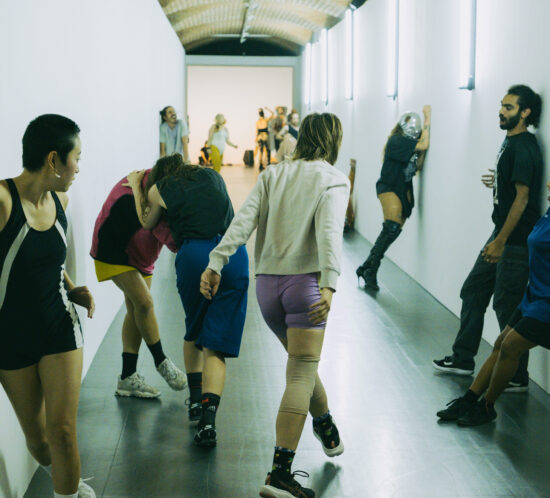
Title Image

Blog

Maria José Arjona (1973) is a Colombian multidisciplinary performance artist whose
work proposes through radical poetic gestures a unique form of political resistance.
At a time when political art is understood primarily as political activism, Arjona instead
treats the body as a site for subtle and complex re- articulations and questionings of
normative conditioning and violence. She moves away from a focus on the identity of
the artist to highlight the organic, expansive shared potential of the body, a body that
in its centrality may not be individual or biographical, but collective and
unconditioned.
Arjona is currently a fellow at the DAAD in Berlin and was a visiting scholar at the
department of performance studies at NYU. Her upcoming and most recent
exhibitions, seminars and talks include: “All possible forests” (Seminar) Princeton
University, “Moving with Rocks” LASA 2025, “Rivers” Biennial Of Guatemala, “Silent
but together” at The Museum Of Contemporary Art Of Barcelona, “The good life" at
The Museum Of Modern Art Of Medellin, Zero Point Berlin , Art Basel Miami Beach,
The international Biennial Of Performance (Argentina), “The Body As Archive” a (Talk)
at Museum Of Latin American Art Of Buenos Aires (MALBA).

Maria Jose Arjona

26th February 2025, from 6pm to 8pm

This online seminar draws upon “As It Is Inside, So It Is Outside”, a project exhibited at NC Arte in Bogotá (COL) in the wake of the pandemic. Emerging from a network of encounters, transformations, and visions, it reflects on the radical generosity that arises in times of crisis and the formation of temporary communities willing to embrace the unknown as a space of possibility. Spanning from the Sierra Nevada de Santa Marta to Bogotá, New York, and Berlin, the project reimagined interactions between non-human entities and a gathering of alchemists, biologists, dancers, sound artists, architects, oracles, anthropologists, chefs, and designers.


Building on these explorations, this seminar invites participants into a space of collective reflection and speculation, where mystery unfolds in the unspoken transmission of movement, the affective architectures emerging between bodies, the vibrational resonance of voices, and the invisible yet deeply felt shifts in molecular motion.

This lecture will be conducted in English and the invited person will be present via video-conference.

Maria Jose Arjona

Palestras PACAP 8 / MyS | Maria Jose Arjona | Forum Dança

Maria José Arjona (1973) is a Colombian multidisciplinary performance artist whose work proposes through radical poetic gestures a unique form of political resistance. At a time when political art is understood primarily as political activism, Arjona instead treats the body as a site for subtle and complex re- articulations and questionings of normative conditioning and violence. She moves away from a focus on the identity of the artist to highlight the organic, expansive shared potential of the body, a body that in its centrality may not be individual or biographical, but collective and unconditioned.


Arjona is currently a fellow at the DAAD in Berlin and was a visiting scholar at the department of performance studies at NYU. Her upcoming and most recent exhibitions, seminars and talks include: “All possible forests” (Seminar) Princeton University, “Moving with Rocks” LASA 2025, “Rivers” Biennial Of Guatemala, “Silent but together” at The Museum Of Contemporary Art Of Barcelona, “The good life” at The Museum Of Modern Art Of Medellin, Zero Point Berlin , Art Basel Miami Beach, The international Biennial Of Performance (Argentina), “The Body As Archive” a (Talk) at Museum Of Latin American Art Of Buenos Aires (MALBA).

General information

Date

26th February 2025, from 18h00 to 20h00


Venue
Forum Dança – Espaço da Penha
Travessa do Calado, 26B, 1170-070 Lisboa


Free entry, subject to capacity.

Top photo © DR

PACAP 8 / Mystery School lectures

Support and Partnerships

Co-Production PACAP 8: Culturgest | Teatro do Bairro Alto | Anda & Fala | Walk e Talk | Goethe-Institut Portugal, in the scope of Kulturfest festival.

Co-producer in Residency PACAP 8: O Espaço do Tempo

Support PACAP 8: Alkantara | Casa da Dança – Almada | Fundação GDA | Kees Eijrond Foundation | OPART, E.P.E/Estúdios Victor Córdon | O Rumo do Fumo | Piscina

Forum Dança | Parcerias e Apoios PACAP 8
Palestras PACAP 8 / MyS | Ezequiel Santos | Forum Dança

Ezequiel Santos

19th February 2025, at 16:30

Portuguese Dance as an Appeal to the Drive for Destiny – A Psychoanalytic Reading

As part of PACAP 8/‘Mystery School’, Ezequiel Santos gives a lecture that proposes a unique approach to dance in Portugal, exploring it as a territory where myth, history and the body intertwine. Through a reading inspired by psychoanalysis, this reflection invites us to think about dance beyond its chronologies and facts, highlighting it as a space of timeless resonances and cultural fictions that manifest themselves in dancing bodies.

As this is the inaugural lecture of the ‘Mystery School’, I propose a descent below the visible plane of facts and chronologies and revisit Portuguese dance through the mythology configured in the very history that the Portuguese have lived. This is a reading inspired by psychoanalysis, which calls for the recovery of the drive for destiny, the understanding of timeless resonances, the description of a mission that has been fulfilled through the spirit, materialised in active cultural fictions that are installed in dancing bodies. Bodies that, under the appearance of the present, carry antiquity within them. | Ezequiel Santos

This lecture will be conducted in English.

Ezequiel Santos

Palestras PACAP 8 / MyS | Ezequiel Santos | Forum Dança
Ezequiel Santos © Ricardo Bastos

Psychologist, psychotherapist, university lecturer in Social Sciences and Humanities, and researcher at INET-md (FMH). He has a PhD in Contemporary Art (CAUC) and has participated in research projects linking the performing arts, social sciences and digital technologies.


He completed CMD II at Forum Dança in 1992 and worked as a performer with choreographers Madalena Victorino, Rui Nunes and Francisco Camacho. Between 1996 and 2006 he was director of Forum Dança’s Choreographic Support Centre, with intense collaboration in international networks of artists and producers.


His interests span several disciplines, predominantly in the thematic areas of dance history, the phenomenology of aesthetic experience, Art Based Research and ecotopias.

General information

Date

19th February 2025, 16:30


Venue
Forum Dança – Espaço da Penha
Travessa do Calado, 26B, 1170-070 Lisboa


Free entry, subject to capacity.

Top photo © Ricardo Bastos

PACAP 8 / Mystery School lectures

Support and Partnerships

Co-Production PACAP 8: Culturgest | Teatro do Bairro Alto | Anda & Fala | Walk e Talk | Goethe-Institut Portugal, in the scope of Kulturfest festival.

Co-producer in Residency PACAP 8: O Espaço do Tempo

Support PACAP 8: Alkantara | Casa da Dança – Almada | Fundação GDA | Kees Eijrond Foundation | OPART, E.P.E/Estúdios Victor Córdon | O Rumo do Fumo | Piscina

Forum Dança | Parcerias e Apoios PACAP 8
Forum Dança - Workshop Butoh 2024 - Yael Karavan

Workshop Butoh
Yael Karavan

14 and 15 of December 2024 | 11h00 – 17h00

Butoh fu – Composition with images, the mysterious language of Ankoku Butoh


Butoh is an avant-garde, radical, revolutionary dance of transformation, which emerged at the end of the 50ese in Japan, it is not a technique but rather a method and a philosophy, an approach to dance that is born within us and connects us to our essence, nature, the universe and the cycles of life and death.

Tatsumi Hijikata, the main Ankoku Butoh Dance Founder (Ankoku Butoh- dance of Darkness) used imagery to choreograph his dancers. Butoh-Fu is something that Yukio Waguri, one of his long time dancers, put together from his own notes of the words used by T.Hijikata when he choreographed his dancers at Asbestos-kan, the studio he led in Tokyo.

In this workshop, Karavan introduces, explores and gives experience of numerous original Butoh-Fu, taking us onto a journey through the origins researching for new ways of writing dance / movement scores. Butoh-Fu allows us to encounter the absurd, dadaist and obscure realms of Tatsumi Hijikata, Kazuo Ohno and Ankoku Butoh.

The main elements that will be explored in the workshop are metamorphoses, dance through imagery, presence, awareness, and the tension between opposites with the aim to free the body from its mundane preconceived set of gestures and movements and thus allowing us to access a deeper and more authentic essence of movement and archetypal expression.

Questioning how Butoh can be translated into a European Body and why Butoh is still extremely relevant nowadays, Karavan shares more than 25 years of Butoh experience, during which she had the opportunity to work with founders of Butoh in Japan, Kazuo Ohno and Motofuji San – wife of T. Hijikata – as well as with Tadashi Endo and MAMU dance theatre, Yumiko Yoshioka and Ten-Pen-Chi, Sankai Juku, Minako Seki, Carlota Ikeda, Akira Kasai, Ko Morobushi and Natsu Nakajuma among others.


Photo © Raul Bartolome

Informations

Select each of the sections below to find out more about the workshop and the enrolment process.

Who is it for

This cycle of workshops is aimed at professionals, students and people with or without previous experience in movement, dance and/or theatre.

Maximum number of participants: 20 people.

Schedule

Dates: 14th and 15th December (Saturday and Sunday) 2024
Times: 11.00 a.m. to 5.00 p.m.

Venue

Forum Dança / Espaço da Penha
Travessa do Calado, 26B
1170-070 Lisboa

Participation fee

    • Until the 7th of December 2024: 77,00 € (early bird discount)
    • As of 8th December 2024: 88,00 €
    • 10% discount: for people who attend or have attended Forum Dança long-term courses (PACAP/CGPAE/PEPCC/etc.).

Pre-registration

Pre-registration is done using the form available on our website and will be validated once proof of payment has been received and sent to our email address.

Registration process

  1. Pre-register online using the form provided;
  2. Wait for our email with payment instructions;
  3. Pay your registration fee as indicated in the email sent to you;
  4. Send us proof of payment to our email address;
  5. Your registration will only be validated once we have received your receipt.

Registration form

All fields are mandatory.

Registrations are now closed.

Bio

Yael Karavan

Yael Karavan
Yael Karavan

International performer, dancer and Artistic director of the Karavan Ensemble, Yael was born in Israel and grew up in Florence, Paris and London. In her dance research she travelled across Europe, Japan, Russia and Brazil searching for a physical language of expression bridging between East and West dance and theatre. Her work is often described as visual poetry, drawing on elements of Butoh, dance, mime, clown, physical and visual theatre she explores themes of Memory, Metamorphosis, the invisible and the notion of repetitive cycles, as well as current urgent socio-political issues such as climate change, immigration, diversity and inequality. Karavan’s work is presented worldwide in theatres, galleries and museums, often in a site-specific context. She studied and worked with Butoh masters such as Kazuo Ohno, Tadashi Endo, Carlotta Ikeda, Yumiko Yoshioka, Akiko Motofuji, Ko Morobushi, Natsu Nakajima, Akira Kasai, Yuko Kaseki, Minako Seki, Atsushi Takenuchi and sankai Juku amongst others. She was a member of Tadashi Endo’s MA-MU Dance Theatre for nearly 8 years and of Ten-Pen-Chi led by Yumiko Yoshioka for 3 years and has been teaching workshops internationally since 1999.


More information: www.yaelkaravan.com

Composição em Tempo Real, João Fiadeiro / Forum Dança

Real Time Composition_Open Sessions_2024

Mondays from 6pm to 8pm

from October 6, 2025 to November, 2025

Facilitated by João Fiadeiro and Márcia Lança

We will continue with the Monday sessions (from 6pm to 8pm), which are free and open to anyone, with or without experience in CTR or even in artistic practices. These sessions have proved to be extremely rich as they create a spontaneous community of study and sharing of this tool, in an informal and inclusive way, slowly establishing itself as the backbone of CTR’s presence at Forum Dança. The sessions will be led by João Fiadeiro and Márcia Lança.

Information

Select each of the sections below to find out more about the open sessions.

Contextualisation

During the period in which REAL (a structure run by João Fiadeiro from 1990-2019) ran Atelier Real, open sessions were organised for the community to practice Real Time Composition, free of charge. These were unpretentious sessions, somewhere between a jam and a master class, which had an important impact on the community of artists at the time and on research into (and around) this tool. They were also very important sessions as a meeting place and for the creation of professional and emotional networks that continue to this day.


Over the next months, as part of the programme of activity developed within the framework of Forum Dança’s Resident Research Artist position, we will replicate these sessions to share our experience, but also to allow ourselves to be contaminated by discourses, perspectives and practices outside our comfort zone. These sessions are open to anyone – artist or non-artist, with or without experience of improvisation, with a background in practice or theory – as long as the premises and principles of this practice arouse curiosity.


“The ‘object of study’ of Real Time Composition is the interval that emerges when linear time is interrupted and the sense of continuity is suspended (via accident, incident or ‘just because’). The space that opens up as a result of this interruption is where Real Time Composition research takes place. Within this space, time has that rare quality of being simultaneously ‘no more’ and ‘not yet’. Within this space, time is not linear (or even circular), but ‘twisted’ (like the topological surface of the ‘Möbius Tape’), governed by laws that do not respect the conventional notions of before and after, inside and outside or far and near.”

João Fiadeiro

Who it's for

The sessions are aimed at anyone who identifies with the premises of the proposal and feels available and comfortable to experiment with composition and improvisation practices with the body.

Schedule

Every Monday from 18.00 to 20.00.

Venue

Forum Dança / Espaço da Penha
Travessa do Calado, 26B
1170-070 Lisboa

Bios

João Fiadeiro

Forum Dança | PACAP 5 - João Fiadeiro
João Fiadeiro © Ana Viotti

João Fiadeiro (1965) is a Portuguese performer, choreographer, researcher, teacher and curator.
He belongs to the generation of artists that emerged at the end of the 1980s in Portugal and gave rise to the New Portuguese Dance movement.
In the 1990s he studied and practised Contact-Improvisation intensively, which led him to pursue and systematise his own research into improvisation under the name Real-Time Composition. This research has led him to coordinate workshops in master’s and doctoral programmes at various schools and universities around the world.
He has toured extensively in Europe, North America and South America with his solo and group works.
His career, whether as a choreographer or performer, or as a researcher or curator, has centred on creating conditions for experimentation, laboratory practice and interdisciplinary cross-fertilisation.
This activity has been carried out both within the framework of directing artistic programming and research projects, which have included the Centro Cultural da Malaposta (1990-95), Espaço Ginjal (1995-1998), Lugar Comum (1999-2000), Espaço A Capital (2000-2002) and Atelier Re.AL (2004-2019), and within the framework of his artistic practice, through creations and research workshops organised around Real-Time Composition.
Atelier Re.AL was a structure that played a leading role in the development of contemporary dance and transdisciplinary initiatives in Portugal.
In all these different meeting platforms, João Fiadeiro was always accompanied by artists who actively participated as creators, performers, researchers and programme-makers, making a decisive contribution to the existence of this project over 30 years of uninterrupted activity.

Márcia Lança

Forum Dança | PACAP 5 - Márcia Lança
Márcia Lança

Márcia Lança was born in Beja and lives in Lisbon. In 2008 she founded VAGAR, of which she is artistic director. She has worked as a choreographer and performer in various collaborative configurations.

She moves in territories where the boundaries between the fictional and the real are tenuous and diffuse. Her interest in the poetic materiality of concrete actions and tasks is at the centre of her creative processes.

She is passionate about emerging collective compositions, thought as action and situated constructions.

Daniel Pizamiglio

Forum Dança | PACAP 5 - Daniel Pizamiglio
Daniel Pizamiglio © Matheus Martins

Daniel Pizamiglio is a Brazilian performer and creator based in Portugal.

In his work he seeks to materialise encounters between the word and the body, and how to activate the corporeality of affections and relationships.

He was João Fiadeiro’s assistant and co-curator of PACAP5 at Forum Dança.

In 2023, she premiered ‘M’, a performance that transforms mourning into a collective and political event.

General Note

For those wishing to take part in any of our CTR transmission and practice programmes


Even though we are committed to creating a safe place of practice, sustained by a work ethic based on principles of care and mutual respect, the experience of improvisation and performance, by definition, can take performers to places of intense sharing, often vulnerable and emotionally charged, where doubt and error have a prominent place. When signing up, bear in mind that in this practice you may find yourself in situations of experimentation that shake up your comfort zones, even if only temporarily.

TECER activities

Forum Dança | Ciclo de Apresentações PACAP 7 | TBA - Teatro do Bairro Alto

PACAP 7 presentations

11 to 14 July | TBA-Teatro do Bairro Alto

PACAP – Advanced Creation Programme in Performing Arts – is a creation/training project organised by Forum Dança and aimed at professionals and students in artistic fields who invest in a period of advanced experimentation, combining research, creation and presentation to the public.

In this seventh edition, PACAP is curated by the artists Miguel Pereira and Nuno Lucas, who propose to publicly show a series of choreographic, performative and installation experiments based on collaboration.

Above all, it will be a time for sharing works in progress, rather than a final presentation, a space open to different formats and configurations.

The intention is to compress all these works into a single weekend, allowing the public to immerse themselves more intensely in the different proposals, while also promoting a potential contamination between them.

The focus of this edition was on the processes, research times and meetings it promoted between the participants and guest artists, trying to create a community of thought and action that goes beyond the six-month duration of the programme.


Miguel Pereira and Nuno Lucas, PACAP 7 curators

Creation (PACAP 7 Participants) Beatriz Baião (PT), Carlota Mantecón (ES), Damien Najean (FR), Giulia Romitelli (IT), Guillermina Gancio (UY), Hernie Harmon (DE), Jakob von Kietzell (DE), Joana Duvet (PT), Katerina Giannouli (GR), Luna Anaïs (CH), Marina de Moraes (BR), Marusya Byzova (RU), Maud Buckenmeyer (FR), Minjin Lee (KR), Renan Capivara (BR) and Sérgio Diogo Matias (PT)

Artistic accompaniment Miguel Pereira and Nuno Lucas

Lighting and technical direction Leticia Skrycky and Santiago Rodriguez Tricot

Production Forum Dança

Co-production Bairro Alto Theatre

Co-production in Residence O Espaço do Tempo

Support Alkantara, Casa da Dança – Almada, GDA Foundation, OPART, E.P.E/Estúdios Victor Córdon, O Rumo do Fumo, Piscina

COMPLETE PROGRAMME

TBA – Teatro do Bairro Alto

Tickets: 3€ for each block (Ticket office)

For more information, visit the TBA website here

11 July [Thursday]

17h | BLOCK I

(tickets here)

  • Beatriz Baião e Sérgio Diogo Matias
  • Joana Duvet
  • Luna Anaïs, Carlota Mantecón e Guillermina Gancio
  • Marina de Moraes
  • Marusya Byzova


20h | BLOCK II

(tickets here)

  • Beatriz Baião e Sérgio Diogo Matias
  • Guillermina Gancio, Katerina Giannouli e Minjin Lee
  • Jakob von Kietzell, Marusya Byzova e Renan Capivara
  • Joana Duvet
  • Marina de Moraes


At the foyer

Katerina Giannouli publication

12 July [Friday]

17h | BLOCK II

(tickets here)

  • Beatriz Baião e Sérgio Diogo Matias
  • Guillermina Gancio, Katerina Giannouli e Minjin Lee
  • Jakob von Kietzell, Marusya Byzova e Renan Capivara
  • Joana Duvet
  • Marina de Moraes


19h30 | BLOCK I

(tickets here)

  • Beatriz Baião e Sérgio Diogo Matias
  • Joana Duvet
  • Luna Anaïs, Carlota Mantecón e Guillermina Gancio
  • Marina de Moraes
  • Marusya Byzova


At the foyer

Katerina Giannouli publication

13 July [Saturday]

16h | BLOCK III

(tickets here)

  • Beatriz Baião e Sérgio Diogo Matias
  • Carlota Mantecón, Damien Najean, Luna Anaïs e Renan Capivara
  • Joana Duvet
  • Marina de Moraes
  • Marusya Byzova
  • Maud Buckenmeyer, Beatriz Baião, Damien Najean, Giulia Romitelli e Jakob von Kietzell


19h30 | BLOCK IV

(tickets here)

  • Beatriz Baião e Sérgio Diogo Matias
  • Damien Najean
  • Giulia Romitelli e Jakob von Kietzell
  • Henri Kirsch / Hernie Harmon
  • Joana Duvet
  • Marina de Moraes
  • Marusya Byzova


At the foyer

Katerina Giannouli publication

14 July [Sunday]

16h | BLOCK IV

(tickets here)

  • Beatriz Baião e Sérgio Diogo Matias
  • Damien Najean
  • Giulia Romitelli e Jakob von Kietzell
  • Henri Kirsch / Hernie Harmon
  • Joana Duvet
  • Marina de Moraes
  • Marusya Byzova


19h | BLOCK III

(tickets here)

  • Beatriz Baião e Sérgio Diogo Matias
  • Carlota Mantecón, Damien Najean, Luna Anaïs e Renan Capivara
  • Joana Duvet
  • Marina de Moraes
  • Marusya Byzova
  • Maud Buckenmeyer, Beatriz Baião, Damien Najean, Giulia Romitelli e Jakob von Kietzell


At the foyer

Katerina Giannouli publication

Top image credits © Guillermina Gancio

Support and Partnerships

PACAP 7 co-producer:  Teatro do Bairro Alto.

PACAP 7 co-producer in Residency: O Espaço do Tempo

PACAP 7 support: Alkantara, Casa da Dança – Almada, Fundação GDA, OPART, E.P.E./Estúdios Victor Córdon, O Rumo do Fumo and Piscina.

Forum Dança | Parcerias e Apoios PACAP 7
Forum Dança - Arte Jovem

Arte Jovem 2024

The summer workshops are back!

Creative Dance, Character Building Lab, Theatre and Video for children aged 7 to 12.

Another school year is coming to an end, the summer holidays are about to start and with them comes another edition of Arte Joven. This year’s activities will take as their starting point the question “What does freedom mean to you?”, a pertinent question to think about and work on in the year that marks the 50th anniversary of the 25 April revolution.


There will be Creative Dance with Carla Ribeiro, a Character Building Laboratory with Andrei Bessa and Theatre and Video with Manuela Pedroso and João Pinto. The youngest will be able to dance, sing, write, play, learn, create, think, interpret and create stories with new friends. On the last day there’s time to invite all the family and friends to attend a final presentation of the work done.

Cartaz Arte Jovem 2024 | Forum Dança
Cartaz Arte Jovem 2024

Program from July 15th to 19th


  • Creative Dance, with Carla Ribeiro, from 10:15 am to 11:30 am
  • Character Building Lab, with Andrei Bessa, from 11:45 am to 1:00 pm
  • Theater and Video, with Manuela Pedroso and João Pinto, from 2:30 pm to 5:15 pm
  • Final presentation: Friday, July 19th at 5 pm


Important informations


  • Arte Jovem takes place from the 15th to the 19th of July, with activities between 10:15 and 17:15.
  • The age group of the participants is between 7 and 12 years old.
  • All participants must have completed at least the 1st year of compulsory school education.
  • We welcome participants from 9:30 am and they can stay until 6:30 pm.
  • Every day there will be a break for lunch and play, which takes place between 1:00 pm and 2:30 pm.
  • Participants bring lunch and snacks from home (don’t forget bring cutlery too). Forum Dança ensures the heating of meals and monitoring of children/young people
  • Friday, July 19th at 5:00 pm: invitation to family members to attend the presentation of the work developed throughout the week.

Participation Fee

  • Full day – €130,00
  • Morning periods – €75,00 (midday)
  • Afternoon periods – €75,00 (half-day)


Discount

Minus 10% for siblings, residents of Penha de França and Forum Dança students in the current academic year (2023/24).


Registration and more information

Registrations are made using the form available on our website (below, on this page) and requests for more information should be sent to our email.

Activities Calendar

10h15 – 11h30
Creative Dance workshop

With Carla Ribeiro

11h45 – 13h00
Character Building Lab

With Andrei Bessa

LUNCH & PLAY

14h30 – 15h45 / 16h – 17h15
Theater and Video Workshop

With Manuela Pedroso and João Pinto

10h15 – 11h30
Creative Dance workshop

With Carla Ribeiro

11h45 – 13h00
Character Building Lab

With Andrei Bessa

LUNCH & PLAY

14h30 – 15h45 / 16h – 17h15
Theater and Video Workshop

With Manuela Pedroso and João Pinto

10h15 – 11h30
Creative Dance workshop

With Carla Ribeiro

11h45 – 13h00
Character Building Lab

With Andrei Bessa

LUNCH & PLAY

14h30 – 15h45 / 16h – 17h15
Theater and Video Workshop

With Manuela Pedroso and João Pinto

10h15 – 11h30
Creative Dance workshop

With Carla Ribeiro

11h45 – 13h00
Character Building Lab

With Andrei Bessa

LUNCH & PLAY

14h30 – 15h45 / 16h – 17h15
Theater and Video Workshop

With Manuela Pedroso and João Pinto

10h15 – 11h30
Creative Dance workshop

With Carla Ribeiro

11h45 – 13h00
Character Building Lab

With Andrei Bessa

LUNCH & PLAY

14h30 – 15h45 / 16h – 17h15
Theater and Video Workshop

With Manuela Pedroso and João Pinto

17h00
Final presentation to family and friends.

Teachers

Andrei Bessa

Forum Dança - Arte Jovem 2024 - Andrei Bessa
Andrei Bessa

Andrei Bessa is a performer, director and researcher from Fortaleza (BR). He has a Master’s degree from the Postgraduate Programme in Arts (UFC, Brazil). Artist with Inquieta Cia. and Vagar Associação Cultural. Collaborator with Thereza Rocha’s study group “Dramaturgia: o que quer e o que pode o corpo?”. In 2021, he moved to Lisbon to research at PACAP 5 (Forum Dança), curated by João Fiadeiro. Among her various research projects, she also produces art for children, with a greater emphasis on theatre. In this area, she directed and wrote the plays “Esconderijo dos Gigantes” (2015) and “Quem tem medo do escuro?” (2009).

Carla Ribeiro

Carla Ribeiro
Carla Ribeiro

Carla Ribeiro starts studying Classical and Modern dance with Igor Ivanoff and Madalena Victorino.

She graduated from Escola Superior de Dança and took the Dança na Comunidade course at Forum Dança. In her further training she works with Carolyn Carlson, Ann Papoulis, Stephanie Skura and Mestre Noro.

As a performer, highlights include shows performed with Olga Roriz Companhia de Dança, Susana Vidal, Marina Nabais Dança, John Mowat, Tânia Carvalho/Aza Companhia, Companhia Paulo Ribeiro, Ricardo Pais, O Útero, Pigeons International, Nuno Carinhas, Teatro O Bando , etc.

In addition to her artistic activity, she teaches Contemporary Dance at Forum Dança and Creative Dance at Colégio Cesário Verde.

As a teacher, she took classes in Contemporary Dance at Forum Dança, Inclusive Dance at Fundação Liga, Creative Dance at Colégio Cesário Verde (and current Cesário Verde International School) and Body Classes at AMA.

João Pinto

Forum Dança - João Pinto
João Pinto

João Pinto (aka PTV), director, editor & image manipulator. Completed the superior film school in 1993. He collaborated with numerous creators in the field of contemporary dance, music, theater and cinema:

Aldara Bizarro, Filipa Francisco, Paulo Ribeiro, Vítor Rua, Nuno Rebelo, Carlos Barreto, Fernando Mora Ramos, Edgar Pêra, Miguel Seabra, among others, promoting their works and signing many original video creations.

He has produced video art projects, documentaries, and music videos. Pioneer of video jamming (VJ) from 1996 to the present day. He participated in educational and innovative Art projects in public schools: Projecto Respira (2009/10) and “Somos Nós” (2021). He has worked on several development projects with minorities (Alkantara Festival and Calouste Gulbenkian Foundation 2008/11), “Nu Kre Bai Na Bu Onda” and “Tapete”. “A Preguiça Ataca?”, documentary complement to the contemporary dance piece (2022). “A Mulher Azul”, directing a short film for RTP Palco (2022).

Manuela Pedroso

Forum Dança - Arte Jovem 2024 - Manuela Pedroso
Manuela Pedroso

Manuela Pedroso has a degree in Theatre/Training of Actors and Directors by Escola Superior de Teatro e Cinema, in Lisbon. She attended the Community Dance Monitor Course organized by Forum Dança, in 1992/93.

Since 1986 she works as a professional actress in several theatre companies; Teatro Espaço, Teatro da Malaposta, Teatro do Século, Teatro Meridional, Casa Conveniente, among others; directed by the directors: Águeda Sena, José Martins, Figueira Cid, Rui Mendes, Mário Feliciano, Inês Câmara Pestana, Miguel Seabra, Layla Ripol, Mónica Calle, Inês Barahona, Giacomo Scalisi, Miguel Fragata, João de Brito, and Caroline Bergeron.

She participated as an interpreter in the Dance area in choreographic projects by Margarida Pinto Coelho, Paulo Henrique, and Madalena Victorino.

She has been working since 1991 as a trainer in the field of Theater and Creative Dance with various official entities that promote artistic education in Portugal.

Registration form

Registrations are closed.

Forum Dança | Workshop de Kung Fu | Guilherme da Luz

Kung-Fu Workshop
Guilherme da Luz

25th and 26th May 2024, from 3pm to 6pm

“When you go deep into anything, it’s a dance”

Kung fu has always been considered the martial art of warrior dancers. Several practitioners of dance, theatre and performance artists consider that Kung Fu reinforces their roots and centers them for performance, thinking of the unique, fluid and spiral aesthetic for their personal and professional development.

What to expect from this two-day meeting: get in touch with exercises and fragrances to be able to risk/express with style.

Informations

Select each of the sections below to find out more about the workshop and the enrolment process.

Who is it for

This cycle of workshops is aimed at professionals, students and people with previous experience in movement, dance and/or theatre.

Maximum number of participants: 20 people.

Schedule

Workshop: 25 and 26 May 2024, from 3 p.m. to 6 p.m.

Venue

Forum Dança / Espaço da Penha
Travessa do Calado, 26B
1170-070 Lisboa

Participation fee

    • Registration fee: 40 € (forty euros), for both days;
    • 10% discount: for people who attend or have attended Forum Dança long-term courses (PACAP/CGPAE/PEPCC/etc.).

Pre-registration

Pre-registration is done using the form available on our website and will be validated once proof of payment has been received and sent to our email address.

Registration process

  1. Pre-register online using the form provided;
  2. Wait for our email with payment instructions;
  3. Pay your registration fee as indicated in the email sent to you;
  4. Send us proof of payment to our email address;
  5. Your registration will only be validated once we have received your receipt.

Registration form

All fields are mandatory.

Registrations are closed.

Bio

Guilherme da Luz

Forum Dança | Workshop de Kung Fu | Guilherme da Luz
Guilherme da Luz © Alexandra Afonso

Guilherme da Luz started on the path of Kung-Fu as a reminder of an art/practice that came from a past before him.


Going through various experiences of Chinese and Persian Kung-Fu, he realized that he wanted to live a Kung-Fu in which the Human Being is placed at the center in the foreground and everything else, schools, theories, philosophies exist for people and not the other way around, calling this method Lotus Flower.


For forty years teaching creative Kung-Fu for integral development on a daily basis.

Performers dancing against a white wall

PACAP 8
2025

Performing Arts Advanced Programme

Meg Stuart

From 10th of February to 26th of July 2025

Applications closed.

“Every new beginning
leads you to a mystery.
Every beginning carries
that potential of the unknown.
It relates to how we move,
how we hear, how we listen,
how we spend time with something,
how we see what is around us.”
Meg Stuart

Introduction

PACAP 8 / Mystery School of Choreography
Concept and Artistic Direction: Meg Stuart
Artistic Collaboration: Ana Rocha

Proposal

Forum Dança invites choreographer Meg Stuart as a curator for the 8th edition of PACAP to take place in Lisbon, 2025, who proposes her concept and project Mystery School of Choreography. For this edition, Meg Stuart has invited Ana Rocha as artistic collaborator.


Mystery School of Choreography (MyS) is an unconventional experimental studies programme for performing artists. It’s a place where fascination for the metaphysical will be intertwined with composition, choreography, and art making.


During these six months, from February to July 2025, we will work in the studio at Forum Dança, in the theatre space at Teatro do Bairro Alto, in the galleries at Culturgest, surrounded by nature and far from the Portuguese capital at O Espaço do Tempo, Montemor-o-Novo, and in São Miguel Island, Azores, in Walk&Talk Biennial. From the indoor space to the street, we will go through these residencies together for reflection and practice.


MyS will consist of encounters with artists who will share their personal cosmology, expertise, and process. Participants will approach MyS themes through moments of reflection and, above all, through collective moments of performance and dialogue. MyS proposes to create a space that is not about converting or indoctrinating, but about revealing and creating structures for the process of sharing.


How can we connect to that knowledge more precisely? By starting from a position of not-knowing. MyS seeks to cultivate the attitude of the beginner, letting go and shedding expectations. By starting from what fascinates us, we are also practicing a sense of wonder, a lucid dreaming together. We will be guided by nature, cause and effect, energetic transformation, disorientation and divination, sacred geometry, rhythmic visions and voice, alchemy, love and politics, non-locality and quantum physics, deep and inner contemplation.


MyS takes transmission of hidden knowledge and insights, which are not accessible through conventional means, as a foundation of learning and creating art through a shared exploration.


MyS will focus on questions that go beyond purely physical practices and can be explored in a collective dimension, such as:


How can we foster imagination in ourselves in correlation with our surroundings?
How can we (re)align our research processes within an interdimensional wonder?
How can we negotiate and learn from indeterminacy, non-defined corporeal spaces, and invisible realms as much as fictional futures?
How can we create a more holistic, compassionate understanding of it?
How do we share fascination?
How do we value different functions and forms, different kinds of material and research?
How do we develop and cultivate a fountain of creative collaboration with energies, seen and unseen forces?


MyS is a step towards a deeper understanding of learning, practice, and activation of knowledge that is often present in performing arts but not directly addressed. In MyS we will sketch possibilities for the future of dance and community.

Participants

PACAP 8 / MyS programme is designed as a transformative journey. At MyS, we will work together: environmentally aware, socially engaged, going through metaphysical access to transform deep learning into a political act. We will work together with the body and the voice, with critical perceptive thinking.


We are looking for experienced professional performance artists open to work in a collective art programme. Makers and dreamers who have a strong interest in the interweaving of the metaphysical and art, with a generosity of spirit, free-thinkers, open for a shared, rigorous and playful exploration of the unknown. MyS programme looks for participants who have done inner emotional work, grounded, nonconformist, sensitive to other’s processes and highly motivated. Participants are required to be flexible, passionate about improvisation, open to chance procedures and experimental structures.


During the MyS programme, be ready to let go of preconceived notions, be willing to trust a collective process and design other possible futures through an experimental, intensive, and rigorous process. Participants will have the opportunity to research and compose in various formats and settings. MyS is a six-month collaborative programme, where participants will be co-creators and collaborators with nature, forces unknown and invited artists.

Information

Invited guests

  • Benoît Lachambre
  • CAConrad
  • Doug Weiss
  • Gaya de Medeiros
  • Isabela Santana
  • Justin F. Kennnedy
  • Keith Hennessy
  • Márcio Kerber Canabarro
  • Maria F. Scaroni
  • Mariana Tengner Barros
  • Mayfield Brooks
  • Mieko Suzuki
  • Odete
  • Renan Martins
  • Sigal Zouk
  • Xullaji


… and others to be confirmed.

Language

English will be the official language of the programme.


Please note!
Applications must be sent in English.

Dates

  • Applications deadline 31.05.2024
  • Results Pre-selection 17.06.2024
  • Audition Workshop 29.07.2024 – 03.08.2024
  • Final Results 30.09.2024
  • Programme dates 10.02.2025 – 26.07.2025

Schedule

Intensive and flexible schedule. An overview of the working hours will be sent before the beginning of the programme.

Applications

Elements to be sent:


  • CV + 1 photo
  • 3 short video works of your artistic work, including as maker & collaborative projects (Vimeo/ YouTube link)
  • 1 video of something you never did before
  • 1 motivation letter + 1 MyS score in the form of: e.g. texts or images (2 pgs. max.), inspired by the questions below:


    • What do you dream of learning at MyS?
    • Who are your heroes, ancestors, and artistic influences?
    • What does mystery / magic mean to you? Define it.
    • What spiritual experiences inform your artistic work?
    • It will be a collective space. What skills can you offer a group? What are your special powers? What kind of daily practice do you have, how do you organize yourself?
    • What keeps you up at night? What topics obsessed you? What do you need to let go of?
    • Are you comfortable with silence?
    • What’s love got to do with it?

! IMPORTANT NOTE!

We do not accept links that require downloading videos.

The links sent must give direct access to the online visualization of the files (YouTube, Vimeo, etc).

The only files that require downloading that we will accept are the Curriculum vitae, the photo and the motivational letter.

Tuition fees

    • Registration: 200€;
    • Payment in full: 2000€;
    • Payment in two installments: 1100€ x 2.


Please do not let financial concerns prevent you from applying.

If the tuition is a cause of concern for you, please include a letter in your application explaining your financial situation.

Scholarships

There are a few scholarships available:


    • 2 scholarships offering a 50% reduction of the tuition fees.
    • 1 scholarship offering 100% reduction of the tuition fees, aimed at artists from Portuguese Speaking African Countries or Black artists living in Portugal.
    • Artists residing in Portugal are eligible for up to 50% reduction of the tuition fees through scholarships given out by the GDA Foundation (In cases where the applicant is a member of the GDA this increases up to 75%).

Application

Until 31st May 2024

Form

Please note!
Applications and all documentation must be sent in English.


Applications are closed.

Bios

Meg Stuart

Forum Dança | PACAP 8 - Meg Stuart
Meg Stuart © Camille Blake

Choreographer, director, and dancer who lives and works in Berlin and Brussels. With her company, Damaged Goods, founded in 1994, she has created over thirty productions, ranging from solos and duets to group pieces, video works, site-specific creations and improvisation projects.

Stuart’s work moves freely between the genres of dance, theater and visual arts, driven by an ongoing dialogue with artists from different disciplines.

Through fictions and shifting narrative layers, she explores dance as a source of healing and a way to transform the social fabric.

Improvisation is an important part of Stuart’s practice, as a strategy to move from physical and emotional states or the memory of them.

Meg Stuart has received many awards for her work, notably the Golden Lion for Lifetime Achievement at the Biennale di Venezia in 2018, and she was a recipient of a Guggenheim Fellowship in 2023.

More informations: www.damagedgoods.be

Ana Rocha

Forum Dança | PACAP 8 - Ana Rocha
Ana Rocha

Curator, choreographer, performer, playwright, and a teacher. She has been a producer of visual arts, music and performing arts (theatre/contemporary dance), and also works as a production manager for cultural projects.


She mediates in the field of Culture and the Arts, creating a research language of artistic and socio-political action engaged in the potential development of the creative process and its context.


Ana operates in fields of multiplicity and cultural diversity, co-relating points of reflection and transition, by accompanying and consulting institutions, non-profit organizations, artistic collectives, and national and international creators.

Participants

Ana Szopa (PL), António Bollaño (PT), Arash Khakpour (IR), Emily da Silva (BR), Guillermo Tarasewicz (UY), Isabela Rossi (BR/IT), iSaAc iSaBeL Espinoza Hidrobo (EC), Julia Kosałka (PL), Kaya Freeman (PT), María Ibarretxe (ES), Martha Kotsia (GR), Michiru Shin (JP), Natacha Campos (PT), Raul Aranha (IN), Salomé Pham-Van-Hué (FR), Sepideh Khodarahmi (SE/IR), Śomi Śniegocka (PL), Therese Bendjus (DE) and Tiago Vieira (PT).

PACAP 8 Activities

PACAP 8 / Mystery School lectures

Support and Partnerships

Co-Production PACAP 8: Culturgest | Teatro do Bairro Alto | Anda & Fala | Walk e Talk | Goethe-Institut Portugal, in the scope of Kulturfest festival.

Co-producer in Residency PACAP 8: O Espaço do Tempo

Support PACAP 8: Alkantara | Casa da Dança – Almada | Fundação GDA | Kees Eijrond Foundation | OPART, E.P.E/Estúdios Victor Córdon | O Rumo do Fumo | Piscina

Forum Dança | Parcerias e Apoios PACAP 8

Top image credits © Vitorino Coragem

[“Archives for future Spells”, Culturgest 2025]

Tempo Real LAB - Laboratório de estudo, transmissão e aplicação da ferramenta Composição em Tempo Real.

Real Time LAB

Laboratory for the study, transmission and application

of the Real-Time Composition tool

From 30 September to 20 December 2024

A course organised as part of the TECER project, an initiative by João Fiadeiro as Forum Dança’s Resident Artist-Researcher.

Applications closed

“Perhaps present time and past time
Are both present in future time
And future time contained in past time.
If all time is eternally present
All time is irredeemable.”

T. S. Eliot, in Four Quartets


“Real Time Composition is a tool that puts into practice a radical decentring to approach what goes beyond human experience.”
Emma Bigé, philosopher, dancer, curator

Premise

Real-Time Composition is a tool that “runs the risk” of being successful in solving decision and selection problems in improvisation or composition processes. That’s one of its strengths. But that’s not all that drives us. We’re driven by the desire to find strategies for suspending certainty. To find ways of thinking about action and making thoughts act. Finding ways of not knowing together.


TEMPO REAL LAB was born out of the desire to realise this statement.

Proposal

Since Real Time Composition (RTC) began being systematised at the end of the 1990s, João Fiadeiro has been developing strategies to share this tool in an advanced and immersive way, beyond the occasional workshop.


This is a course that gives access to the multiple layers of this practice over the course of its duration, from the different angles and scales that make it up, and with balanced and interconnected doses of thought, experimentation and action.


A course where CTR is understood as a “field of study”, and which manages to reduce the distance between territories that are normally split between theory and practice; the fictional and the documentary; or observation and action.


A course where the appropriation of its tools and concepts happens intuitively and empirically, and where their application responds to the needs of each situation, circumstance and use.


We’ve had powerful and intense examples of this sharing in the past – from the “Case Studies” in the 2000s; AND_Lab in the early 2010s and, more recently, PACAP 5 here at Forum Dança in 2021. But these courses always had a parallel “agenda” – artistic creation, scientific research or the discipline of improvisation sensu lato – whereas CTR was always studied in relation to other ends and never as a “means”, a “between”, a “process”.


And it’s no coincidence that this happened. It’s not easy to set up a transmission platform to teach/share a practice that, to all intents and purposes, “serves no purpose”. Or rather, it serves “nothing”, the idea of “nothing”, here understood not as “absence” or “emptiness”, but as something still open, as potential, without having been contaminated and conditioned by a closed meaning or a label.


But this time, taking advantage of the framework of a CTR Study Centre like TECER, with the perspective of continuity that Forum Dança provides, and the fact that my most direct peers – Márcia Lança, Carolina Campos, Daniel Pizamiglio or Cláudia Dias – already have their own body of work in the research, transmission and application of CTR, we feel ready to dive into this void.

Programme and Timetable

TEMPO REAL LAB will last 12 weeks (from 30 September to 20 December 2024) and will consist of 4 modules of 3 weeks each. Each module consists of a week dedicated to experimenting with one of the performative devices that synthesise Real-Time Composition and two weeks dedicated to studying the backbone of the tool (from its cardinal axis, premises, and principles) and a “focus experiment” of Real-Time Composition.


The very desire to draw up a timetable and a kind of “curriculum” is, at first glance, contrary to the nature of the practice of Real-Time Composition, which is to not to be domesticated and which, in its core modus operandi, inhabits the imponderable and the indeterminate. On the other hand, we also know that the rituals and protocols resulting from frameworks such as “course”, “laboratory” or even “school” are nothing more than generic references that attract people to a place. Once together, it is the people who decide what they are actually doing there. All things going well, the power structures associated with these terms will be deactivated, becoming mere pretexts that have mobilised us towards a meeting point. This encounter is the necessary condition for exchange and sharing, the ultimate goal of a transmission and research project.


Synthesis-Devices
The synthesis-devices that we will explore are the result of practices developed over the years of CTR’s research and reflect concerns such as: the relationship between performativity and the presence of the spectator, restriction and task as enhancers of environments of performative freedom, the relationship between word and action, the transit between affects, enunciations and their manifestations. These are concerns that synthesise the principles and premises that underpin his practice, especially those in which there is a displacement of the spatio-temporal perception of the event, of the synaesthetic type, where the senses cross, collide and overlap. Towards the start of the course, participants will be given details of each of the devices to be explored.


In the first week of each module, through the synthesis devices, we will have the chance to inhabit the CTR experience even before we begin to peel back the various layers that make it up. This action seems absolutely necessary to destabilise the “think first and do later” tendency so present in our Cartesian habits of access to knowledge. In this way, we want to “protect ourselves from ourselves” by reversing the order of the factors, placing ourselves first inside the experience in order to then study its echoes and aftershocks. As the course progresses, even this inversion will be subverted and access to the experience will take place without a clear distinction between practice and theory, in an attempt to blur and abolish the hierarchical boundaries between doing and thinking.


At the end of each week, the study of these devices will have a public presentation (four in total). This will allow us to study a central aspect of this practice: the influence of external observation on the way we present (and represent) ourselves. These presentations will also function as ways of “publishing” the experience (in the sense of leaving a public mark), thus producing discourse and creating an archive, one of TECER’s programme axes.


Backbone
During the mornings, the meeting point will be with João Fiadeiro and his collaborators, in order to study and experiment with Real-Time Composition from its cardinal axis, its premises and structuring principles, both from the point of view of its concepts and the tools that support it. This period will focus more on how the “machine” works and less on its applicability. If we think of a biological analogy, the CTR will be studied here as if it were a “stem cell”, still undifferentiated, which could become a “specialised” cell (muscle, blood or brain) at any moment.


Focus experiment
In the afternoon, the focus will shift to different forms of experimentation and application of this tool, based on the appropriation made over the years by artists such as Márcia Lança, Carolina Campos, Daniel Pizamiglio and Cláudia Dias, who have worked/are working intensively with João Fiadeiro and who have developed their own approaches to this tool. These sessions will allow participants to access different voices within Real-Time Composition, reinforcing the idea that, while it is a rigorous methodology with precise principles and premises, it is also open and permeable to the unique sensibility of those who incorporate it (both those who transmit it and those who receive it).


For this reason, the “study areas” designed for these sessions will be a direct consequence of the interests, imaginations and experiences of each artist who will guide the sessions. Depending on who is sharing it, and the angle from which it is approached, we will simultaneously be faced with repetition (of technique) and difference (of approach). This diagonal and oblique quality is part of the structure of this proposal and transmitting it through a multiple experience is the logical consequence of the way it operates.


A more detailed programme of individual intentions by each artist facilitating the sessions will be shared closer to the course.

Target audience

We are looking for experienced professional artists, linked to performance and contemporary dance, who identify with a transversal, hybrid and oblique position of artistic thought-making. It is important that they already have a consistent body of work of reflection and experimentation, even if they are still at the beginning of their careers, in order to establish themselves as a collective of peers, available for a generous and reciprocal exchange of equals.


Even when a safe place of research is created, sustained by a work ethic based on principles of care and mutual respect, the practice of improvisation and performance, by definition, can take performers to places of intense sharing, often vulnerable, where doubt and error have a prominent place. We are therefore looking for profiles of participants who are emotionally mature enough to cope with situations of experimentation that shake them up, even if only a little.

Informations

Select each of the sections below to find out more about the course and the application process.

Language

The course will be conducted in English and Portuguese.


Important!
Applications can be sent in Portuguese and/or English.

Dates

After receiving the dossier, the shortlisted applicants will be invited by 19 July 2024 to an online interview (via zoom) with João Fiadeiro and the curatorial team. Applicants will be informed of the final decision by 5 August 2024.


  • Pre-selection 15.07.2024 – 18.07.2024
  • Pre-selection results 19.07.2024
  • Interviews 25.07.2024 – 26.07.2024
  • Final Answers by 05.08.2024
  • Programme dates 30.09.2024 – 20.12. 2024

Schedules

The daily schedule of this course will be divided into a morning session and another session in the afternoon.

The course will take place from Tuesday to Thursday, with Fridays dedicated to self-organised group activities.


  • 10h00 – 12h30 – morning session
  • 13h30 – 17h15 – afternoon session

Venue

Forum Dança / Espaço da Penha
Travessa do Calado, 26B
1170-070 Lisboa | Portugal

Applications

Elements to be sent:


  • Motivation letter with the reasons why you are applying (max. 1 page A4 .pdf)
  • CV with photograph and a short biography included (max. 2 pages A4 .pdf)
  • Portfolio in pdf format or website where the history of your creations can be accessed, published texts or collaborations, with links to video recordings.


  • A text answering the following question (max. 1/2 page A4 .pdf): Where does the light go when it goes out?
  • An image that translates the following sentence: “All things are delicately interconnected”
  • A sentence that translates the following image:
FORM

! IMPORTANT NOTE !

We do not accept links to download videos.
The links sent must give direct access to viewing the files online (Youtube, Vimeo, etc.).

Fees

  • Enrolment 120 €
  • Full payment of the course 800 €
  • Payment in 2 instalments 420 € x 2

Scholarships

A reduction of 50 % of the tuition fee scholarship will be awarded upon selection.

Application Form

All fields are mandatory.

Applications are now closed.

Bios

João Fiadeiro

Forum Dança | PACAP 5 - João Fiadeiro
João Fiadeiro © Ana Viotti

João Fiadeiro (1965) is a Portuguese performer, choreographer, researcher, teacher and curator.
He belongs to the generation of artists that emerged at the end of the 1980s in Portugal and gave rise to the New Portuguese Dance movement.
In the 1990s he studied and practised Contact-Improvisation intensively, which led him to pursue and systematise his own research into improvisation under the name Real-Time Composition. This research has led him to coordinate workshops in master’s and doctoral programmes at various schools and universities around the world.
He has toured extensively in Europe, North America and South America with his solo and group works.
His career, whether as a choreographer or performer, or as a researcher or curator, has centred on creating the right conditions for experimentation, laboratory practice and interdisciplinary cross-fertilisation.
This activity has been carried out both within the framework of directing artistic programming and research projects, which have included the Centro Cultural da Malaposta (1990-95), Espaço Ginjal (1995-1998), Lugar Comum (1999-2000), Espaço A Capital (2000-2002) and Atelier Re.AL (2004-2019), and within the framework of his artistic practice, through creations and research workshops organised around Real-Time Composition.
Atelier Re.AL was a structure that played a leading role in the development of contemporary dance and transdisciplinary initiatives in Portugal.
In all these different meeting platforms, João Fiadeiro has always been accompanied by artists who have actively participated as creators, performers, researchers and programme-makers, making a decisive contribution to the existence of this project over 30 years of uninterrupted activity.

Márcia Lança

Forum Dança | PACAP 5 - Márcia Lança
Márcia Lança

Márcia Lança was born in Beja and lives in Lisbon. In 2008 she founded VAGAR, of which she is artistic director. She has worked as a choreographer and performer in various collaborative configurations.
She moves in territories where the boundaries between the fictional and the real are tenuous and diffused. Her interest in the poetic materiality of concrete actions and tasks is at the centre of her creative processes.
She is passionate about emerging composition collectives, thought as action and situated constructions.

Carolina Campos

Forum Dança | PACAP 5 - Carolina Campos
Carolina Campos

Carolina Campos is Brazilian and lives between Lisbon and Barcelona.
She completed the Independent Studies Programme at the Barcelona Museum of Contemporary Art.
In Brazil she worked with Lia Rodrigues Cia de Danças between 2008 and 2011.
Since 2013 she has collaborated intensively with João Fiadeiro in the training, creation and research of Real Time Composition.
In Barcelona she is associated with the Scottish Creation Centre.

Daniel Pizamiglio

Forum Dança | PACAP 5 - Daniel Pizamiglio
Daniel Pizamiglio © Matheus Martins

Daniel Pizamiglio is a Brazilian performer and creator.
From 2008 to 2010 he attended the Technical Dance Course in Fortaleza (2008-2010). During this period, he met choreographer João Fiadeiro and from this encounter he moved to Lisbon in 2012, where he currently lives and works.
Since then, he has studied and practised Real-Time Composition; he took part in Forum Dança’s Study, Research and Choreographic Creation Programme (2015-2016); he has collaborated as a performer, co-creator and assistant director with different artists.
In his authorial work, he seeks an encounter between poetry and the body (“Concrete Dance”) and how to activate the corporeality of affects and relationships (“Pay Attention To Everything From Now On”).

Cláudia Dias

Cláudia Dias 
© Adriano Miranda
Cláudia Dias © Adriano Miranda

Cláudia Dias was born in Lisbon in 1972. She is a choreographer, performer and teacher. She began her dance training at the Academia Almadense, was awarded a scholarship at the Companhia de Dança de Lisboa, completed the Contemporary Dance Performers Training Course at Forum Dança, and attended the Master’s Degree in Performing Arts at the Faculty of Social and Human Sciences, Universidade Nova de Lisboa. She began her work as a performer with the Almada Dance Group. She was a member of the collective Ninho de Víboras. She collaborated with Re.Al and was a central interpreter in João Fiadeiro’s creative strategy and in the development, systematisation and transmission of the Real-Time Composition Technique. She created the pieces Feedback, E.U. (entrevista-me urgentemente), Juntem-se 2 a 2, As águias não geram pombas, Per Ti, Histo, One Woman Show, Visita Guiada, Das coisas nascem coisas, Vontade de ter Vontade, 23 + 1 and Nem tudo o que dizem tem de ser feito nem tudo o que fazemos tem de ser dito. She was an associate artist at Re.Al and Espaço do Tempo and a resident artist at Alkantara. She has published texts in the magazines Boa União and Woman On Scene and in the books Correspondencias.Bad and Escenas do Cambio. She won the Young Creators competition by the Portuguese Arts and Ideas Club in 1998. Nominated for the Best Choreography Award in 2013 and 2017 by the Portuguese Society of Authors. Since 2016 she has been developing the project Sete Anos Sete Peças (Seven Years, Seven Pieces), accumulating functions of direction, creation, interpretation and training. She created the association Sete Anos.

TECER activities

CTR Workshop
Body as space

From August 26th to 30th, 2024, from 2:00 p.m. to 6:00 p.m.

Sensitivity to initial conditions II
An introduction to Real Time Composition: body as space


In this workshop, João Fiadeiro will collaborate with performer and artist Márcia Lança to create and study how the initial conditions for the practice of Real-Time Composition are established. The game will always start, as an initial protocol, from positions and relations generated by Márcia and João, which will function as an initial reference for exploring and experimenting with Real-Time Composition. These initial positions-relations will function as micro-scores that will condition the experience of the practice. Finding the experience of freedom within a score-environment composed of restrictions, while at the same time developing autonomous and inter-dependent relationships with those who play (humans and non-humans), will be the “object of study” of this workshop.

Informations

Select each of the sections below to find out more about the workshop and the enrolment process.

Who is it for

This cycle of workshops is aimed at artist-researchers with experience in improvisation (in dance, performance or theatre).

Maximum number of participants: 16 people.

Schedules

Summer workshop: From 26 to 30 August 2024, from 14h00 to 18h00.

Venue

Forum Dança / Espaço da Penha
Travessa do Calado, 26B
1170-070 Lisboa

Participation fee

    • Registration fee: €100 (one hundred euros);
    • 10% discount: for people who attend or have attended Forum Dança long-term courses (CGPAE/PEPCC/etc.);
    • 25% discount: for people who attend or have attended PACAP.

Pre-registration

Pre-registration is done using the form available on our website and will be validated once proof of payment has been received and sent to our email address.

Registration process

  1. Pre-register online using the form provided;
  2. Wait for our email with payment instructions;
  3. Pay your registration fee as indicated in the email sent to you;
  4. Send us proof of payment to our email address;
  5. Your registration will only be validated once we have received your receipt.

Registration form

All fields are mandatory.

Registrations are closed.

Contextualisation

Select each of the sections below to find out more.

*Real Time Composition

* Real Time Composition is a term used in a wide range of artistic interactions and contexts, most commonly in the field of electronic music and its relationship with computer science. In the field of contemporary dance, it is used by many artists as a synonym for the practice of “improvisation” (a term somewhat “hijacked” by common sense as an arbitrary, disorganized or chaotic experience), in order to emphasize the complexity and rigor involved in the act of improvising, especially when presented publicly.


When João Fiadeiro began his research into improvisation in the 1990s, the expression most often used to claim this rigor was “instant composition”. Intuitively João Fiadeiro decided to adopt the notion of ” real time composition” to designate his research, because it was the term that best corresponded to the experience of expanded, distended and plastic time that he had when “colliding” with the unknown, whether when improvising or composing. He was later able to better formulate this resistance to the term “instantaneous” when he realized that an important part of the hypothesis he put forward as a researcher, on the performer’s experience with time, was based on the premise that the idea of an “instant” is made by the human being, who has decided, out of interest (and profit) that an instant is the thinnest slice of time and that successive instants replace the previous one.


More recently, by accessing the writings of authors who think about the concept of time, this reasoning has gained even more ground. In particular through the formulation of “operative time” that Giorgio Agamben uses in “The Time That Remains”. To defend his hypothesis, Agamben relies on the linguist Gustave Guillaume (1883-1960) who states (in his book Temps et Verbe) that “all mental experience, however rapid [it may be], requires a certain amount of time, which may be very brief, but is no less real”. What Guillaume defines as “operative time” (and João Fiadeiro as “real time”) is exactly “the time that the mind uses to realize an image-time”. Agamben complements this reasoning when he says that “a careful examination of the phenomena of language shows that languages organize their verbal systems not according to the preceding linear scheme (…) but through the reference of the constructed image in the operative time of its construction.” Operative time (or, as Fiadeiro would say, “real time”) “is neither the line – representable but unthinkable – of chronological time, nor the instant – equally unthinkable – of its end, and even less a segment extracted from chronological time (…). It is rather the operative time that urges on chronological time and works and transforms it from within, time that we need in order to bring time to an end – in this sense: the time that remains.”


When discussing the term “instant” or “real time” to designate the type of “improvisation” João Fiadeiro researches, he is not referring to the time shared between improviser and spectator, but to the internal time of the performer, in the management of the experience that mediates the identification, circumscription and processing of stimuli; the selection and choice of relation possibilities; and their consequent manifestation in the form of gesture and action.


João Fiadeiro’s use of the expression Real Time Composition to describe his research and practice must be understood in the light of this reflection.

João Fiadeiro

Forum Dança | PACAP 5 - João Fiadeiro
João Fiadeiro © Ana Viotti

João Fiadeiro (1965) belongs to the generation of artists who emerged in the late eighties in Portugal and gave rise to Nova Dança Portuguesa [New Portuguese Dance], a movement highly influenced by the Judson Dance Theater in America and New Dance scene in Europe.


Between 1990 and 2019 he was Atelier RE.AL’s artistic director, a venue that played a major role in the development of contemporary dance and trans-disciplinary initiatives in Portugal, both within art and between art, science and society. Among the projects organized by this association, the LAB/Moving Projects (1992-2006), a work-in-progress platform from emergent artists; “Restos, rastos e traços” (Leftovers, tracks and traces) and “G.host” (2009-2011), two residency programs focused on documentation practices for contemporary art; and the project AND_Lab (2011-2014), a research laboratory working on the relationship between ethics, aesthetics and politics, are among the initiatives that had the biggest impact in the community.


João Fiadeiro has toured extensively throughout Europe, North America and South America with his solo and group works. His pieces navigate in-between disciplines (performance, dance and theater), contexts (theaters, museums or site-specific) and formats (choreographies, happenings or lecture-performances), in an attempt to maintain a “radical sensitivity” towards the present and remain vigilant against any form of stagnation or loss of critical discourse.


Between 1995 and 2003 he collaborated with Artistas Unidos (United Artists), a Lisbon based theater company, where he was responsible for the movement of the actors in pieces from Silva Melo, Shakespeare, Brecht, Goethe, etc.. For this company he also staged plays by Samuel Beckett (Waiting for Godot), Sarah Kane (Psychosis 4’48’’) and Jon Fosse (Nightsongs).


Parallel to his work as a choreographer, theater director and curator, João Fiadeiro studied and practiced intensively Contact-Improvisation in the 90’s which led him to pursue and systematize his own research on improvisation under the designation of Real Time Composition. This research, which started as a tool to support his own creative practices, has since been used by researchers from art and science (coming from fields as diverse as anthropology, complex systems sciences or economy), as a theoretical-practical platform to study decision-making, representation and collaboration. This work has led him to teach extensively in different independent venues in Europe and South America (Brasil, Uruguay, Argentina and Chile) and to lead workshop sessions in the most important master programs and schools in Europe that relate to contemporary dance like PACAP/Forum Dança; EXERCE Master, MA in Arts Practice and Visual Culture at Rainha Sofia Museum; SoDA MA Program; Performing Studies at the Hamburg University; Amsterdam Master of Choreography; Master of Theatre DasArts; a.pass_advanced performance and scenography studies; MA Theatre Academy of the University of the Arts Helsinki; Villa Arson; Centre National de la Danse, etc.


The Real Time Composition tool has since expanded its application outside the artistic field with initiatives like “Soft Skills for Hard Decisions”, designed in collaboration with the economist António Alvarenga and applied in human resources departments of foundations; or the discipline “Social Stigmergy” designed for the PhD program at ISCTE University in Lisbon with the complex system scientist Jorge Louçã.


In 2018 João Fiadeiro published his book “Anatomy of a Decision” where he synthesized his life long research on Real Time Composition and in 2019 co-curate (with Romain Bigé) the exhibition Drafting Interior Techniques at Culturgest Gallery, the first retrospective look taken at Steve Paxton work and legacy.

Márcia Lança

Forum Dança | PACAP 5 - Márcia Lança
Márcia Lança

Márcia Lança was born in Beja and lives in Lisbon. In 2008 she founded VAGAR, of which she is artistic director. She has worked as a choreographer and performer in various collaborative configurations.


She moves in territories where the boundaries between the fictional and the real are tenuous and diffuse. Her interest in the poetic materiality of concrete actions and tasks is at the centre of her creative processes.


She is passionate about emerging collective compositions, thought as action and situated constructions.


More information here

TECER activities

CTR Workshop
Space as body

From April 1st to 5th, from 2:00pm to 6:00pm

Sensitivity to initial conditions I
An introduction to Real-Time Composition: space as body


In this workshop, João Fiadeiro will collaborate with architect and artist João Gonçalo Lopes to create the initial conditions for practicing Real Time Composition. The game will always start, as an initial protocol, from a “prepared space” (a bit like John Cage’s “prepared piano”), which will function as a territory for exploring and experimenting with Real Time Composition. This preparation will create a spatial topography which, through the obstructions and restrictions created, will condition the experience of the practice. Finding the experience of freedom within a score-environment composed of restrictions, while developing autonomous and inter-dependent relationships with those who play (humans and non-humans), will be this workshop’s “object of study”.

Informations

Select each of the sections below to find out more about the workshop and the enrolment process.

Who is it for

This cycle of workshops is aimed at artist-researchers with experience in improvisation (in dance, performance or theatre).

Maximum number of participants: 16 people.

Schedules

Easter Workshop: From 1 to 5 April 2024, from 14h00 to 18h00.

Venue

Forum Dança / Espaço da Penha
Travessa do Calado, 26B
1170-070 Lisboa

Participation fee

    • Registration fee: €100 (one hundred euros);
    • 10% discount: for people who attend or have attended Forum Dança long-term courses (CGPAE/PEPCC/etc.);
    • 25% discount: for people who attend or have attended PACAP.

Pre-registration

Pre-registration is done using the form available on our website and will be validated once proof of payment has been received and sent to our email address.

Registration process

  1. Pre-register online using the form provided;
  2. Wait for our email with payment instructions;
  3. Pay your registration fee as indicated in the email sent to you;
  4. Send us proof of payment to our email address;
  5. Your registration will only be validated once we have received your receipt.

Registration form

All fields are mandatory.

Registrations are now closed.

Contextualisation

Select each of the sections below to find out more.

*Real Time Composition

* Real Time Composition is a term used in a wide range of artistic interactions and contexts, most commonly in the field of electronic music and its relationship with computer science. In the field of contemporary dance, it is used by many artists as a synonym for the practice of “improvisation” (a term somewhat “hijacked” by common sense as an arbitrary, disorganized or chaotic experience), in order to emphasize the complexity and rigor involved in the act of improvising, especially when presented publicly.


When João Fiadeiro began his research into improvisation in the 1990s, the expression most often used to claim this rigor was “instant composition”. Intuitively João Fiadeiro decided to adopt the notion of ” real time composition” to designate his research, because it was the term that best corresponded to the experience of expanded, distended and plastic time that he had when “colliding” with the unknown, whether when improvising or composing. He was later able to better formulate this resistance to the term “instantaneous” when he realized that an important part of the hypothesis he put forward as a researcher, on the performer’s experience with time, was based on the premise that the idea of an “instant” is made by the human being, who has decided, out of interest (and profit) that an instant is the thinnest slice of time and that successive instants replace the previous one.


More recently, by accessing the writings of authors who think about the concept of time, this reasoning has gained even more ground. In particular through the formulation of “operative time” that Giorgio Agamben uses in “The Time That Remains”. To defend his hypothesis, Agamben relies on the linguist Gustave Guillaume (1883-1960) who states (in his book Temps et Verbe) that “all mental experience, however rapid [it may be], requires a certain amount of time, which may be very brief, but is no less real”. What Guillaume defines as “operative time” (and João Fiadeiro as “real time”) is exactly “the time that the mind uses to realize an image-time”. Agamben complements this reasoning when he says that “a careful examination of the phenomena of language shows that languages organize their verbal systems not according to the preceding linear scheme (…) but through the reference of the constructed image in the operative time of its construction.” Operative time (or, as Fiadeiro would say, “real time”) “is neither the line – representable but unthinkable – of chronological time, nor the instant – equally unthinkable – of its end, and even less a segment extracted from chronological time (…). It is rather the operative time that urges on chronological time and works and transforms it from within, time that we need in order to bring time to an end – in this sense: the time that remains.”


When discussing the term “instant” or “real time” to designate the type of “improvisation” João Fiadeiro researches, he is not referring to the time shared between improviser and spectator, but to the internal time of the performer, in the management of the experience that mediates the identification, circumscription and processing of stimuli; the selection and choice of relation possibilities; and their consequent manifestation in the form of gesture and action.


João Fiadeiro’s use of the expression Real Time Composition to describe his research and practice must be understood in the light of this reflection.

João Fiadeiro

Forum Dança | PACAP 5 - João Fiadeiro
João Fiadeiro © Ana Viotti

João Fiadeiro (1965) belongs to the generation of artists who emerged in the late eighties in Portugal and gave rise to Nova Dança Portuguesa [New Portuguese Dance], a movement highly influenced by the Judson Dance Theater in America and New Dance scene in Europe.


Between 1990 and 2019 he was Atelier RE.AL’s artistic director, a venue that played a major role in the development of contemporary dance and trans-disciplinary initiatives in Portugal, both within art and between art, science and society. Among the projects organized by this association, the LAB/Moving Projects (1992-2006), a work-in-progress platform from emergent artists; “Restos, rastos e traços” (Leftovers, tracks and traces) and “G.host” (2009-2011), two residency programs focused on documentation practices for contemporary art; and the project AND_Lab (2011-2014), a research laboratory working on the relationship between ethics, aesthetics and politics, are among the initiatives that had the biggest impact in the community.


João Fiadeiro has toured extensively throughout Europe, North America and South America with his solo and group works. His pieces navigate in-between disciplines (performance, dance and theater), contexts (theaters, museums or site-specific) and formats (choreographies, happenings or lecture-performances), in an attempt to maintain a “radical sensitivity” towards the present and remain vigilant against any form of stagnation or loss of critical discourse.


Between 1995 and 2003 he collaborated with Artistas Unidos (United Artists), a Lisbon based theater company, where he was responsible for the movement of the actors in pieces from Silva Melo, Shakespeare, Brecht, Goethe, etc.. For this company he also staged plays by Samuel Beckett (Waiting for Godot), Sarah Kane (Psychosis 4’48’’) and Jon Fosse (Nightsongs).


Parallel to his work as a choreographer, theater director and curator, João Fiadeiro studied and practiced intensively Contact-Improvisation in the 90’s which led him to pursue and systematize his own research on improvisation under the designation of Real Time Composition. This research, which started as a tool to support his own creative practices, has since been used by researchers from art and science (coming from fields as diverse as anthropology, complex systems sciences or economy), as a theoretical-practical platform to study decision-making, representation and collaboration. This work has led him to teach extensively in different independent venues in Europe and South America (Brasil, Uruguay, Argentina and Chile) and to lead workshop sessions in the most important master programs and schools in Europe that relate to contemporary dance like PACAP/Forum Dança; EXERCE Master, MA in Arts Practice and Visual Culture at Rainha Sofia Museum; SoDA MA Program; Performing Studies at the Hamburg University; Amsterdam Master of Choreography; Master of Theatre DasArts; a.pass_advanced performance and scenography studies; MA Theatre Academy of the University of the Arts Helsinki; Villa Arson; Centre National de la Danse, etc.


The Real Time Composition tool has since expanded its application outside the artistic field with initiatives like “Soft Skills for Hard Decisions”, designed in collaboration with the economist António Alvarenga and applied in human resources departments of foundations; or the discipline “Social Stigmergy” designed for the PhD program at ISCTE University in Lisbon with the complex system scientist Jorge Louçã.


In 2018 João Fiadeiro published his book “Anatomy of a Decision” where he synthesized his life long research on Real Time Composition and in 2019 co-curate (with Romain Bigé) the exhibition Drafting Interior Techniques at Culturgest Gallery, the first retrospective look taken at Steve Paxton work and legacy.

João Gonçalo Lopes

João Gonçalo Lopes
João Gonçalo Lopes © Gustavo Ciríaco

João Gonçalo Lopes is an architect working across disciplines between art, design and education. Having had a diverse experience in different parts of the globe, he is currently working with a hands-on approach on scales that go from urban design, to art instalations or furniture design.


With a context based attitude, his work is rooted in collaboration and community building processes, focusing on the ecology of materials as means to achieve conscious and complex realities.


He values spaces and objects that exist as enablers of experience. For this he uses a broad set of tools that come from different disciplines be it social, political, artistic, constructive or spatial.


More information here.

TECER activities

TECER | CTR 2024

The weekly sessions, occasional workshops and annual courses organized by TECER | CTR at Forum Dança aim to multiply the platforms for accessing Real Time Composition, both in terms of intensity and proposed contents.


In 2024 we are offering two workshops – at Easter and in the summer – entitled “Sensitivity to Initial Conditions: an introduction to Real Time Composition”. These are practical workshops, where bodies are invited to act and interact, so although it is open to performers, researchers and artists from any artistic discipline or area of thought (as long as they are curious about the concepts presented in this presentation), there must be a physical predisposition for participation. The main language will be Portuguese. If there are participants who do not speak Portuguese, we will try to organize forms of shared translation within the group. Registrations will be accepted on a first-come, first-served basis.

Easter Workshop

From April 1st to 5th, from 2:00pm to 6:00pm

Sensitivity to initial conditions I
An introduction to Real-Time Composition: space as body

Summer Workshop

From August 26th to 30th, from 2:00 p.m. to 6:00 p.m.

Sensitivity to initial conditions II
An introduction to Real Time Composition: body as space

Composição em Tempo Real, João Fiadeiro / Forum Dança

CTR open sessions

Every Monday from 6pm to 8pm

Sessions open to the community
With the facilitation of João Fiadeiro, Márcia Lança, Cláudia Dias, Carolina Campos and/or Daniel Pizamiglio.

Tempo Real LAB - Laboratório de estudo, transmissão e aplicação da ferramenta Composição em Tempo Real.

Intensive CTR program

From September 30th to December 20th 2024


Intensive 12-week research and experimentation programme in Real-Time Composition.

TECER activities

Palestra "A Minha História da Dança", por Mark Tompkins

Mark Tompkins

28 March 2024, at 18h30
Espaço da Penha – Lisbon
Approximate duration: 2 hours

Free entry, subject to capacity.


An American dancer, choreographer, singer and teacher, he founded the I.D.A. Company in 1983. His way of making unidentified performance objects, mixing dance, music, song, text and video, has become his signature. Solos, group pieces, concerts and improvised performances are all elements of this journey, which began in the 1970s, with the complicity of set and costume designer Jean-Louis Badet in 1988. His passion for real-time composition has led him to collaborate with dancers, musicians, light designers and video makers. Recognised for his teaching, he travels all over the world. In 2008, he was awarded the SACD Choreography Prize for his work as a whole (Society of Dramatic Authors Composers).


Fascinated by the frictions and resonances between high and low entertainment, his shows are inspired by popular forms such as cabaret, music hall, musicals and burlesque, as well as themes of ambiguity and ambivalence. She sings and dances in the concerts of Sarah Murcia & musicians, NEVER MIND THE FUTURE and MY MOTHER IS A FISH, and collaborates with choreographer Mariana Tengner Barros in A POWER BALLAD and RESURRECTION. He recently published ONE SHOT dialogues on real time composition, with Meg Stuart and the images of Gilles Toutevoix at Editions L’œil d’or. His most recent performances: a solo STAYIN ALIVE (2018) and a trio CELEBRATION (2021).


Photo © Denise Luccioni

10 years
Espaço da Penha

Celebrate with us!

March 16, Saturday from 4pm to midnight
Espaço da Penha, Travessa do Calado 26B, Lisboa
Free entry

A workspace can also be a home. Home in the sense of welcome, warmth and well-being. Espaço da Penha is our home. A house that has been in existence for 10 years. And everyone who passes through here understands the importance of this designation. Espaço da Penha is a house for dance, for those who make dance. Despite the problems and difficulties that a house always entails, we’ve always tried to give the best welcome to those who come to us.


Currently, Espaço da Penha is home to O Rumo do Fumo, Forum Dança, Theory-Fiction and the group of artists from Piscina. But several other structures and artists have passed through here, including Teatro do Vestido, Teatro do Eléctrico, Causas Comuns, casaBranca, Frame Colectivo, Stró, Carta Branca, Miguel Loureiro and João Tuna.


We want this to continue to be a place for encounters and sharing. And there’s nothing like a party to announce our desire to continue this project, so O Rumo do Fumo and Forum Dança invite everyone to come along on 16 March, starting at 4pm, at Espaço da Penha. We’ve prepared several surprises. There are performances to watch, cake to sing happy birthday, sparkling wine to toast, music to dance to. And a house with open doors to welcome you today and, we hope, for many more years to come.


Artistic proposals by


  • Teresa Silva & Mestre André
  • Márcia Lança, Andrei Bessa, Barbara Cordeiro e Nicole Gomes
  • PACAP 7 / Forum Dança
  • Vera Mantero, Mark Tompkins, Mariana Tengner, Miguel Pereira & Nuno Rebelo
  • Djset Os Grilos
Real Time Composition, João Fiadeiro / Forum Dança

TECER | CTR 1

Time | Study | Composition | Experimentation | Real 2

“If we observe the spider at work, what it eventually weaves first (…) is not the web; what eventually happens is that the little pearl that it weaved, suspended on the end of the thread carried by the wind, finds a branch [a wall, a corner]. (…) Is it possible to say that the spider has the project of weaving its web? I don’t think so. It’s better to say that the web has the project of being woven.”


Fernand Deligny, O Aracniano

Presentation

TECER | CTR is a project directed by João Fiadeiro as part of his role as artist-researcher in residency at Forum Dança. Through this platform, João Fiadeiro intends to transmit the study (and study the transmission) of Real Time Composition*, a (theoretical) practice and a (practical) theory that offers itself as a “field”, a place-territory that aims to welcome and host the forces at play in what we conventionally call the present. Within this present and from RTC’s perspective, an expanded time moves, simultaneously “no more” and “not yet”. A non-linear time, experienced like a Möbius band, with no inside or outside, with no before nor after. A time where the shadow, the margin and the fragment have the same prominence as what is in the light, in the center and in the whole. A time when positions are taken so that com3 -positions can take place.


To share Real Time Composition from the potency within the “not-knowing” and not from the power carried by the “knowing”. To share Real Time Composition, reducing the distance and the split between theory and practice, process and product, action and observation, action and procrastination, memory and forgetting, teaching and learning.


This is TECER | CTR ambition as a center for the study and experimentation of Real Time Composition.


1 TECER | CTR is the Portuguese acronym for Weaving Real Time Composition.
2 Time, Study, Composition, Experimentation, Real.
3 In Portuguese, the preposition “com” means “with” and taking a position-with instead of com-posing (arriving with a readymade “with”) is the performer’s main challenge in this practice. Following and repeating this modus operandi will eventually give place to a set of relations between positions (position-with-position-with-position-with- position…) which is how an emergent system can be generated within this practice.

Contextualisation

Select each of the sections below to find out more.

Sensitivity to Initial Conditions

In Real Time Composition, the rules of the game are defined as the game is played and not, as in most games (including the game of life) before the game begins. Before beginning the practice of Real Time Composition, what is established as common ground are the premises and principles that govern the game, in a kind of collective ethical commitment where its singularity is circumscribed, its cardinal axes are defined, and the conceptual framework of this practice is established. In general terms, the three premises that guide this commitment can be summarized using simple coordinates:

  1. You don’t explain your move.
  2. You don’t play twice in a row.
  3. You don’t correct the previous move.

Following (and as a result of) these initial restrictions, the game unfolds in a fine and meticulous management by the players, of the doses of repetition and difference that, at each move, are introduced into the system.


Another key concept in this practice is the principle of “non-linearity”. In Real Time Composition, it is always the subsequent action that retroactively establishes the rules of the game (of that game is being played, because as soon as the game in question ends, the rules are instantaneously obsolete). That’s why you can only really talk about a game when you are halfway through. In other words, for most of the time Real Time Composition experience isn’t spent playing the game but finding the game. This encounter takes place a) when, from a position, you establish a relation; and b) when, from that relation you establish an operation. This process takes place in three stages:

  1. The time when a “position” takes place.
  2. The time when a “com (with)” takes place (creating a “positioning-with” type of relationship).
  3. The time when a “positioning-with” takes place (creating a “positioning-with-positioning” type of operation).

The resulting “positioning-with-positioning” operation works like an equation, a fractal that expands into what we call instant, moment or present. Developing a sensitivity to this triad – positioning-with-positioning – is the necessary condition to play Real Time Composition’s game.

*Real Time Composition

* Real Time Composition is a term used in a wide range of artistic interactions and contexts, most commonly in the field of electronic music and its relationship with computer science. In the field of contemporary dance, it is used by many artists as a synonym for the practice of “improvisation” (a term somewhat “hijacked” by common sense as an arbitrary, disorganized or chaotic experience), in order to emphasize the complexity and rigor involved in the act of improvising, especially when presented publicly.


When João Fiadeiro began his research into improvisation in the 1990s, the expression most often used to claim this rigor was “instant composition”. Intuitively João Fiadeiro decided to adopt the notion of ” real time composition” to designate his research, because it was the term that best corresponded to the experience of expanded, distended and plastic time that he had when “colliding” with the unknown, whether when improvising or composing. He was later able to better formulate this resistance to the term “instantaneous” when he realized that an important part of the hypothesis he put forward as a researcher, on the performer’s experience with time, was based on the premise that the idea of an “instant” is made by the human being, who has decided, out of interest (and profit) that an instant is the thinnest slice of time and that successive instants replace the previous one.


More recently, by accessing the writings of authors who think about the concept of time, this reasoning has gained even more ground. In particular through the formulation of “operative time” that Giorgio Agamben uses in “The Time That Remains”. To defend his hypothesis, Agamben relies on the linguist Gustave Guillaume (1883-1960) who states (in his book Temps et Verbe) that “all mental experience, however rapid [it may be], requires a certain amount of time, which may be very brief, but is no less real”. What Guillaume defines as “operative time” (and João Fiadeiro as “real time”) is exactly “the time that the mind uses to realize an image-time”. Agamben complements this reasoning when he says that “a careful examination of the phenomena of language shows that languages organize their verbal systems not according to the preceding linear scheme (…) but through the reference of the constructed image in the operative time of its construction.” Operative time (or, as Fiadeiro would say, “real time”) “is neither the line – representable but unthinkable – of chronological time, nor the instant – equally unthinkable – of its end, and even less a segment extracted from chronological time (…). It is rather the operative time that urges on chronological time and works and transforms it from within, time that we need in order to bring time to an end – in this sense: the time that remains.”


When discussing the term “instant” or “real time” to designate the type of “improvisation” João Fiadeiro researches, he is not referring to the time shared between improviser and spectator, but to the internal time of the performer, in the management of the experience that mediates the identification, circumscription and processing of stimuli; the selection and choice of relation possibilities; and their consequent manifestation in the form of gesture and action.


João Fiadeiro’s use of the expression Real Time Composition to describe his research and practice must be understood in the light of this reflection.

João Fiadeiro

Forum Dança | PACAP 5 - João Fiadeiro
João Fiadeiro © Ana Viotti

João Fiadeiro (1965) belongs to the generation of artists who emerged in the late eighties in Portugal and gave rise to Nova Dança Portuguesa [New Portuguese Dance], a movement highly influenced by the Judson Dance Theater in America and New Dance scene in Europe.


Between 1990 and 2019 he was Atelier RE.AL’s artistic director, a venue that played a major role in the development of contemporary dance and trans-disciplinary initiatives in Portugal, both within art and between art, science and society. Among the projects organized by this association, the LAB/Moving Projects (1992-2006), a work-in-progress platform from emergent artists; “Restos, rastos e traços” (Leftovers, tracks and traces) and “G.host” (2009-2011), two residency programs focused on documentation practices for contemporary art; and the project AND_Lab (2011-2014), a research laboratory working on the relationship between ethics, aesthetics and politics, are among the initiatives that had the biggest impact in the community.


João Fiadeiro has toured extensively throughout Europe, North America and South America with his solo and group works. His pieces navigate in-between disciplines (performance, dance and theater), contexts (theaters, museums or site-specific) and formats (choreographies, happenings or lecture-performances), in an attempt to maintain a “radical sensitivity” towards the present and remain vigilant against any form of stagnation or loss of critical discourse.


Between 1995 and 2003 he collaborated with Artistas Unidos (United Artists), a Lisbon based theater company, where he was responsible for the movement of the actors in pieces from Silva Melo, Shakespeare, Brecht, Goethe, etc.. For this company he also staged plays by Samuel Beckett (Waiting for Godot), Sarah Kane (Psychosis 4’48’’) and Jon Fosse (Nightsongs).


Parallel to his work as a choreographer, theater director and curator, João Fiadeiro studied and practiced intensively Contact-Improvisation in the 90’s which led him to pursue and systematize his own research on improvisation under the designation of Real Time Composition. This research, which started as a tool to support his own creative practices, has since been used by researchers from art and science (coming from fields as diverse as anthropology, complex systems sciences or economy), as a theoretical-practical platform to study decision-making, representation and collaboration. This work has led him to teach extensively in different independent venues in Europe and South America (Brasil, Uruguay, Argentina and Chile) and to lead workshop sessions in the most important master programs and schools in Europe that relate to contemporary dance like PACAP/Forum Dança; EXERCE Master, MA in Arts Practice and Visual Culture at Rainha Sofia Museum; SoDA MA Program; Performing Studies at the Hamburg University; Amsterdam Master of Choreography; Master of Theatre DasArts; a.pass_advanced performance and scenography studies; MA Theatre Academy of the University of the Arts Helsinki; Villa Arson; Centre National de la Danse, etc.


The Real Time Composition tool has since expanded its application outside the artistic field with initiatives like “Soft Skills for Hard Decisions”, designed in collaboration with the economist António Alvarenga and applied in human resources departments of foundations; or the discipline “Social Stigmergy” designed for the PhD program at ISCTE University in Lisbon with the complex system scientist Jorge Louçã.


In 2018 João Fiadeiro published his book “Anatomy of a Decision” where he synthesized his life long research on Real Time Composition and in 2019 co-curate (with Romain Bigé) the exhibition Drafting Interior Techniques at Culturgest Gallery, the first retrospective look taken at Steve Paxton work and legacy.

General Note

For those wishing to take part in any of our CTR transmission and practice programmes


Even though we are committed to creating a safe place of practice, sustained by a work ethic based on principles of care and mutual respect, the experience of improvisation and performance, by definition, can take performers to places of intense sharing, often vulnerable and emotionally charged, where doubt and error have a prominent place. When signing up, bear in mind that in this practice you may find yourself in situations of experimentation that shake up your comfort zones, even if only temporarily.

TECER activities

Loading new posts...
No more posts